How a Mortgage Prepayment Penalty Locked a Family Into a Rate It Couldn’t Refinance

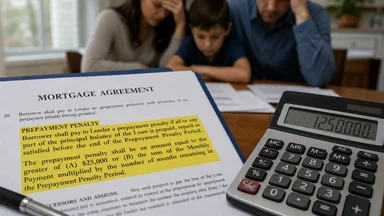
In early 2023, a family in the Pacific Northwest closed on a $548,250 jumbo mortgage at a fixed rate of 6.5%. Eighteen months later, prevailing rates had dropped to roughly 4.5%, offering a potential monthly savings of about $300. But when they contacted their lender to refinance, they discovered a clause buried in their closing documents: a prepayment penalty equal to 3% of the outstanding balance—over $16,000. The penalty, combined with closing costs, made refinancing cost-prohibitive. The family was locked into a rate they could not escape.
The Rate Trap That Refinancing Couldn't Fix
This case, reported by a major consumer finance outlet in 2025, illustrates a problem that persists despite years of regulatory attention. The family's loan was a conventional jumbo, exceeding the conforming loan limit set by the Federal Housing Finance Agency. At the time of origination, the 6.5% rate was considered competitive. The borrower accepted a slightly lower upfront rate in exchange for agreeing to the prepayment penalty—a trade-off that seemed reasonable when rates were expected to rise.
But when the Federal Reserve began cutting rates in late 2024, the calculus shifted. By mid-2025, a 30-year fixed mortgage could be had for around 4.5%. The family calculated that refinancing would save them roughly $300 per month on principal and interest. However, the prepayment penalty of 3% on the remaining balance—about $16,000—meant they would need more than 50 months of savings just to break even on the penalty alone, not counting the $4,000 in closing costs.
The lender refused to waive the penalty, citing the terms of the loan agreement. The family was stuck. They explored a no-cash-out refinance with a different lender, but the penalty still applied upon payoff of the original loan. The only way to avoid the penalty was to wait until the penalty period expired—which was set at three years from origination, meaning mid-2026.
This is not an isolated incident. According to data from Freddie Mac, roughly 20% of conventional mortgages originated in recent years carry some form of prepayment penalty, though the prevalence is higher among jumbo loans and non-qualified mortgages.
How a Standard Clause Became a Shackle
Prepayment penalties were common in the subprime era, often used to discourage borrowers from refinancing when rates fell. The Dodd-Frank Act of 2010 restricted their use on qualified mortgages (QMs), but the rules left loopholes. Loans that exceed the QM threshold—typically jumbo loans above the conforming limit, which in 2023 was $726,200 in most areas—are exempt from the ban. State-level protections vary widely.
The clause is often framed as a benefit to the borrower: a slightly lower interest rate in exchange for agreeing not to prepay for a set period. Lenders argue that the penalty compensates them for the cost of originating a loan that may be paid off early. For lenders, early payoff means losing the stream of interest payments they expected. The penalty is designed to recover some of that loss.
But the fine print is easy to overlook at closing. The Loan Estimate and Closing Disclosure do highlight prepayment penalties, but the language can be dense. In the family's case, the penalty was listed on page 2 of the Closing Disclosure, in a section titled "Prepayment Penalty." It stated: "If you pay off the loan early, you may have to pay a penalty of up to 3% of the amount you still owe." The borrower acknowledged seeing the clause but assumed they would not need to refinance within the penalty period.
That assumption proved costly. The penalty period was three years, but the family planned to move in two years. They did not anticipate that rates would drop significantly within that window. When they did, the penalty effectively eliminated any benefit from refinancing.
Adding to the complexity, the penalty was structured as a declining percentage: 3% in the first year, 2% in the second, and 1% in the third. But because the family triggered it in the second year, the penalty was 2% of the balance—still over $10,000. Even if they had waited until the third year, the 1% penalty would have been around $5,400, which, combined with closing costs, would still have pushed the break-even point beyond two years.
The Break-Even Math That Didn't Add Up
To understand why the family could not refinance, consider the numbers. Their outstanding balance after 18 months was approximately $539,000. The prepayment penalty at 3% was $16,170. Closing costs for the new loan were estimated at $4,000, bringing total upfront costs to roughly $20,000. Monthly savings from refinancing from 6.5% to 4.5% would be about $300. The break-even point—the time needed to recoup the costs—was over 66 months, or 5.5 years.
The family planned to move in two years. Even if they stayed, the break-even period exceeded the remaining penalty period. If they moved before the break-even point, they would have lost money on the refinance. The only scenario that made sense was if they stayed in the home for more than five years—and even then, the penalty consumed a large portion of the savings.
This math is not unique. Many borrowers with prepayment penalties face similar break-even calculations. The penalty is often structured as a declining percentage: 3% in year one, 2% in year two, 1% in year three. But even a 1% penalty on a $500,000 loan is $5,000—enough to delay the break-even point significantly.
Consider another example: a borrower in Texas with a $350,000 conventional loan at 6.75% with a 2% prepayment penalty in the first two years. When rates dropped to 5%, they calculated a monthly savings of $220. But the penalty of $7,000 plus $3,500 in closing costs meant a break-even of 48 months. The borrower had a job transfer pending in 18 months, making refinancing a net loss. Like the family in the Pacific Northwest, they were locked in.
Consumer advocates argue that the break-even period should be disclosed at closing, not just the penalty amount. The Consumer Financial Protection Bureau (CFPB) has issued guidance encouraging lenders to provide clear disclosures, but it does not require a break-even analysis. Borrowers are left to do their own math—or, as in this case, fail to do it at all.
Why the Consumer Bureau's Rules Didn't Help
The CFPB's qualified mortgage rule, implemented in 2014, bans prepayment penalties on QMs except under limited conditions. For QMs, penalties are allowed only if the loan has a fixed rate, the penalty period does not exceed three years, and the penalty amount does not exceed 2% in the first two years and 1% in the third year. But the rule applies only to QMs, which are loans that meet certain underwriting standards and have a debt-to-income ratio below 43%.
Jumbo loans, like the one the family obtained, often exceed the conforming loan limit and are not QMs. They are classified as non-QM loans, which are exempt from the penalty ban. As a result, lenders can impose penalties with fewer restrictions. The family's loan had a penalty of 3% in the first year—higher than the QM limit—and a three-year penalty period.
State laws offer inconsistent protection. Some states, like New York and California, restrict prepayment penalties on mortgages under a certain amount. But the family lived in a state with no such law. The federal rule also exempts loans with adjustable rates and loans used for business purposes. The patchwork of regulations means that many borrowers are unaware of the protections—or lack thereof—available to them.
The CFPB has periodically updated its rules, but as of 2026, no federal law bans prepayment penalties on all mortgages. The agency has focused on disclosure improvements, such as requiring lenders to provide a "prepayment penalty disclosure" form at application. But critics say that disclosure alone is insufficient; the penalty itself should be limited or banned on all consumer mortgages.
Some industry representatives counter that prepayment penalties serve a legitimate purpose: they allow lenders to offer lower rates to borrowers who are less likely to prepay. Without penalties, they argue, rates would be slightly higher across the board, impacting all borrowers. However, data from the Urban Institute suggests that the rate reduction for loans with penalties is often modest—typically 0.125% to 0.25%—while the penalty can be substantial. For the family, the lower rate saved them about $20 per month, or $720 over three years, while the penalty was $16,000. The asymmetry is stark.
The Hidden Cost of Locking in a 'Good' Rate
The trade-off that the family accepted—a slightly lower rate in exchange for a prepayment penalty—is common. Lenders offer rate discounts of 0.125% to 0.25% for loans with prepayment penalties. For a borrower who plans to keep the loan for many years, the savings from the lower rate can outweigh the risk of a penalty. But for borrowers who might refinance or sell within the penalty period, the deal can backfire.
In the family's case, the lower rate saved them about $20 per month—$240 per year. Over three years, that is $720 in savings. But the penalty was $16,000. The trade-off was wildly asymmetric. The borrower accepted a tiny benefit for a huge potential cost.
Freddie Mac data from 2024 indicates that roughly 20% of conventional mortgages originated in the prior two years included a prepayment penalty, with the share rising to over 40% for jumbo loans. Many borrowers are unaware of the clause until they try to refinance. A survey by the Consumer Federation of America found that nearly half of borrowers with prepayment penalties did not recall being told about them at closing.
The hidden cost is not just financial; it is psychological. The family felt trapped, unable to take advantage of lower rates that other homeowners were enjoying. They watched as neighbors refinanced and saved hundreds per month, while they remained locked in. The experience soured them on the mortgage process and left them wary of future borrowing.
Lenders defend the practice, arguing that penalties allow them to offer lower rates to all borrowers. Without penalties, they say, rates would be slightly higher across the board. But consumer advocates counter that the benefits are concentrated among borrowers who do not move or refinance, while the costs fall disproportionately on those who do.
What Borrowers Should Demand in Writing
Before signing any mortgage, borrowers should ask for a Loan Estimate that clearly states whether a prepayment penalty exists. The estimate uses a standardized form that includes a section labeled "Prepayment Penalty" on page 2. If the box says "Yes," the borrower should ask for the specific terms: the percentage, the duration, and the method of calculation.
Negotiating for a no-penalty clause is often possible, especially for borrowers with strong credit. Some lenders will waive the penalty if the borrower agrees to a slightly higher rate. The difference in rate is typically small—0.125% to 0.25%—and may be worth avoiding the risk. Borrowers should compare the total cost of the loan with and without the penalty over the expected holding period.
If the borrower plans to sell or refinance within the penalty period, a loan without a prepayment penalty is essential. Even if the borrower plans to stay long-term, life circumstances can change. A job relocation, a divorce, or a sudden need to move can trigger the penalty. The safest option is to choose a loan with zero prepayment cost.
The Closing Disclosure, which borrowers receive three days before closing, also shows the penalty. Borrowers should review it carefully and ask questions. If the penalty is unexpected, they have the right to walk away from the loan, even at closing, though doing so may forfeit any earnest money or application fees. The three-day review period is designed to catch such surprises.
Another practical step is to request a written amortization schedule that includes the penalty calculation. Some lenders provide a hypothetical break-even analysis if asked. Borrowers should also check their state's laws: in states like New York, prepayment penalties are limited to 2% for loans under $500,000, and in California, they are generally prohibited on loans under a certain threshold. Knowing local rules can empower borrowers to push back.
A Cautionary Tale for the Next Refi Wave
As of mid-2026, market expectations point to further rate cuts by the Federal Reserve, potentially triggering another refinance wave. Borrowers who took out mortgages in 2023 and 2024 at rates above 6% may find themselves in a similar position to the family in this story. Those with prepayment penalties will face the same dilemma: pay a large fee to refinance, or wait for the penalty to expire.
The family in this case could not refinance until the penalty period ended in 2026. By then, rates might have risen again. They were forced to gamble on the timing of rate moves—a gamble they did not know they were making when they signed the loan documents.
This cautionary tale underscores the importance of reading the fine print. A single clause can erase thousands of dollars in potential savings. The family's experience is not unique; similar stories appear in consumer complaint databases and news reports. As one consumer advocate put it, "A prepayment penalty is like an anchor tied to your mortgage. It keeps you from moving when the tide turns."
For borrowers entering the market now, the lesson is clear: understand every term of your loan, especially those that limit your options. The next refinance wave may come sooner than you think, and the cost of being locked out can be far greater than any upfront rate discount.
This article is for informational purposes only and does not constitute legal, financial, or professional advice. Mortgage terms vary by lender and jurisdiction. Borrowers should consult a qualified professional before making any decisions.