A Miscalibrated Roofing Class Code Delayed a General Liability Claim by Eight Months

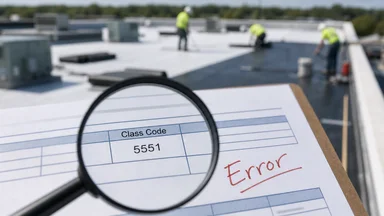
A visitor slipped on ice in the parking lot of a commercial roofing company in the Midwest in early 2023. The injury was not severe—a fractured wrist and some bruising—but the general liability claim that followed took eight months to resolve. The delay was not caused by a dispute over fault or medical bills. It was caused by a three-digit number: the class code assigned to the policyholder's operations. That code, 5551, described steep-slope residential roofing. The company actually performed low-slope commercial roofing. The mismatch was discovered only after the claim was filed, triggering an internal reclassification process that stalled coverage for the better part of a year.
Class codes are the invisible architecture of commercial insurance. Underwriters use them to set premiums, assess hazards, and determine which risks a carrier is willing to write. When the code fits, the machinery works quietly. When it does not, the system seizes up. This article walks through one documented case—based on interviews with the policyholder's broker and coverage attorney—and examines what happens when a classification error meets a real loss. It is a story about process, not blame, and about the gap between what a policy says and what a policy does when the code is wrong.
A Roofing Code That Did Not Fit
The class code 5551 is defined by the Insurance Services Office (ISO) as “Roofing—Residential—Steep-Slope—All Operations.” It covers work on sloped roofs typically found on single-family homes, using materials like asphalt shingles or tile. The hazard profile includes falls from heights, ladder accidents, and exposure to weather. Premiums are calculated accordingly.
The policyholder in this case, a company that had been in business for roughly 12 years, specialized in low-slope commercial roofing—warehouses, strip malls, and office buildings with flat or nearly flat roofs. Their work involved membrane systems, built-up roofing, and occasional repairs. The risk profile is different: fewer falls from steep angles, more trips on flat surfaces, and exposure to heavy equipment. The correct ISO class code for that work is 5552, “Roofing—Commercial—All Operations,” which carries a different loss cost and rating basis.
How did the wrong code end up on the policy? The broker who placed the coverage recalled that the application asked for a description of operations, which the policyholder provided as “roofing.” The underwriter, working quickly during a renewal, selected 5551 from a dropdown menu. The policy was issued without a confirmatory phone call or site visit. The mismatch sat unnoticed for three renewal cycles. As of late 2024, industry surveys suggest that roughly 3–5% of commercial policies contain some form of class-code error, though the true rate may be higher because many errors never surface until a claim occurs.
This type of error is not unique to roofing. Similar mismatches have been documented in other trades. For example, a painting contractor in the Pacific Northwest was assigned a class code for interior painting when most of their work was exterior spray-painting on multi-story buildings. The hazard profile—ladder use, overspray, and scaffolding—differed significantly. When a claim arose from a passerby injured by falling paint chips, the carrier initially denied coverage, citing the code mismatch. The policyholder spent roughly six months and US$ 10,000 in legal fees to get the code corrected and the claim paid. Such cases underscore that classification errors are systemic, not isolated.
How Classification Errors Stall Coverage Decisions
When the slip-and-fall claim arrived, the carrier's claims adjuster opened the file and checked the class code. Under most general liability policies, the adjuster has authority to investigate and settle claims up to a certain dollar threshold. But they cannot override a classification discrepancy. That authority rests with the underwriting department, and often with a specialized rating unit.
The adjuster flagged the issue and escalated it internally. The carrier's underwriting guidelines required that any claim involving a potential misclassification be reviewed by the rating team before coverage could be confirmed. That review involved comparing the policyholder's actual operations against the class-code description, pulling loss-cost data for the correct code, and determining whether the premium that had been charged was adequate. The process took roughly six weeks just for the initial analysis.
During that time, the policyholder received a reservation of rights letter stating that the carrier was investigating whether the claim was covered. The letter cited the class-code mismatch as a potential coverage issue. The policyholder's broker tried to explain the situation to the adjuster, but the adjuster could not act. The internal escalation chain required sign-offs from two managers and a final approval from the regional underwriting director. As one coverage attorney put it, “The adjuster has the keys to the car, but the rating department controls the ignition.”
The policyholder was left in limbo. They could not settle the claim themselves without risking a coverage denial, and they could not get a clear answer from the carrier. The delay stretched from weeks into months. By the time the reclassification was approved—the rating team confirmed that code 5552 was appropriate and that the premium differential was less than 15%—the injury had healed, the claimant's attorney had filed a lawsuit, and the legal costs had started to climb.
The delay also created a tactical disadvantage. The claimant's attorney used the carrier's silence to paint the policyholder as unresponsive. In settlement negotiations, the attorney argued that the policyholder's failure to resolve the claim showed bad faith, even though the policyholder was simply waiting for the carrier. This tactic is common when coverage disputes drag on: the injured party's lawyer exploits the vacuum to pressure the policyholder into a quick, unfavorable settlement. In this case, the policyholder resisted, but the pressure added stress and distraction to an already difficult situation.
The Claim That Exposed the Gap
The claim itself was straightforward. A delivery driver slipped on a patch of ice in the company's parking lot on a January morning. He fell backward, fractured his wrist, and required outpatient surgery. Medical bills totaled roughly US$ 12,000. The driver's attorney sent a demand letter for US$ 35,000, which included lost wages and pain and suffering. The policy had a US$ 1 million general liability limit, so the claim was well within scope.
The carrier's initial denial letter, sent roughly 10 weeks after the claim was filed, stated that coverage was not available because the policy was written for steep-slope residential roofing, and the loss occurred at a commercial premises. The policyholder's broker argued that the class code was an administrative error, not a coverage exclusion. The carrier responded that the code determined the premium and the risk accepted, and that paying the claim would be “outside the intended scope of the policy.”
The policyholder hired a coverage attorney who specializes in commercial insurance disputes. The attorney sent a formal letter to the carrier's claims department, citing state insurance regulations that require carriers to honor coverage when a classification error is inadvertent and the premium differential is minimal. The carrier's legal team pushed back, arguing that the code was an essential element of the contract. The dispute dragged on for another five months.
Ultimately, the carrier's internal rating team completed the reclassification and approved coverage. The claim was paid roughly eight months after the initial filing. The policyholder's attorney fees totaled US$ 18,000—more than the medical bills themselves. The carrier did not admit fault, but it did issue a revised policy with the correct class code at the next renewal. The policyholder, frustrated by the process, switched carriers at the end of the term. The case is a reminder that a class-code mismatch is not just a paperwork problem; it is a real obstacle to getting a claim paid on time.
But not all classification disputes end this way. In some cases, carriers refuse to reclassify, leaving policyholders with no coverage at all. Consider a landscaping company in the Southeast that was assigned a class code for lawn maintenance but performed tree-trimming work. When a tree limb fell on a client's car, the carrier denied coverage, arguing that tree trimming was a higher-hazard operation not covered by the code. The policyholder's broker had not verified the code at binding, and the carrier refused to reclassify retroactively. The policyholder had to pay the claim out of pocket—roughly US$ 20,000—and then sue the agent for negligence. That case settled for US$ 15,000, but the policyholder's business never fully recovered. The contrast between the two outcomes highlights how much depends on the carrier's willingness to correct errors and the policyholder's ability to advocate for themselves.
Regulatory Scrutiny on Classification Accuracy
State insurance regulators have taken notice of classification errors in recent years. The National Association of Insurance Commissioners (NAIC) includes class-code accuracy as a review area in market conduct examinations. Several states, including California and New York, have issued fines to carriers for systemic misclassification practices. In one notable case from 2021, a carrier was fined roughly US$ 150,000 for assigning incorrect class codes to more than 200 policies over a three-year period.
The ISO updated its advisory class codes in 2022, adding more granular descriptions for roofing and other trades. The update aimed to reduce ambiguity, but it did not mandate how carriers implement the codes. Each carrier still has discretion to map ISO codes to their own rating systems, which can introduce new mismatches. As of late 2024, there is no uniform audit standard across states for class-code accuracy. Some states require carriers to document the rationale for code selection at binding; others do not.
Consumer advocates argue that the burden of classification accuracy should fall on carriers, not policyholders. They point out that policyholders often lack the expertise to verify that a code matches their operations. Trade groups for independent agents counter that agents should be held accountable for reviewing codes during the application process. The debate is ongoing, and the regulatory landscape remains fragmented. For now, the safest route for policyholders is to treat class-code verification as a shared responsibility—and to document every step.
There is also a counter-argument worth considering: some in the industry believe that too much regulatory pressure could lead to defensive underwriting, where carriers over-classify risks to avoid fines, driving up premiums for everyone. For example, if a carrier is uncertain about a roofing contractor's operations, they might assign the highest-hazard code to be safe, even if the actual risk is lower. This could result in policyholders paying more than they should, creating a different kind of fairness problem. Regulators must balance the need for accuracy against the risk of unintended consequences. The current fragmented approach may be imperfect, but it allows for experimentation and local adaptation.
What Policyholders Can Do Before a Loss
Policyholders can take several concrete steps to reduce the risk of a class-code mismatch. First, at the time of policy binding, ask the agent or broker to provide the specific class code assigned to each operations description. Do not accept a generic phrase like “roofing” without a code number. Second, compare the official ISO code description—available through most agency management systems—to the actual work performed. If the description mentions “steep-slope residential” and your work is “low-slope commercial,” flag it immediately.
Third, ask the agent to provide a written explanation of why a particular code was chosen. This documentation can be critical if a dispute arises later. Fourth, review the classification annually with the broker during renewal, especially if the business has added new services or changed its mix of work. Mid-term changes—such as expanding into a new line of work—should be reported to the carrier in writing, and the class code should be updated if needed.
Fifth, consider asking the carrier for a “classification confirmation letter” at binding. Some carriers will issue a letter stating that the assigned code has been reviewed and matches the operations described. This letter does not guarantee that a claim will be paid, but it shifts the burden of proof if a mismatch is discovered later. In the roofing case described earlier, none of these steps were taken. The policyholder assumed the code was correct because the premium seemed reasonable. That assumption cost them eight months of delay and thousands in legal fees.
Sixth, policyholders should consider using a checklist during the application process. A simple list—including items like “confirm class code matches operations,” “request written explanation,” and “verify code annually”—can prevent oversights. Some brokers provide such checklists as a value-added service, but many do not. Policyholders should not assume the broker will catch every error; the ultimate responsibility lies with the business owner who knows their operations best.
The Hidden Cost of a Mismatched Code
The direct cost of the eight-month delay in the roofing case was roughly US$ 18,000 in attorney fees—more than the claim itself. But the indirect costs were higher. The unresolved claim sat on the policyholder's loss run for the entire period, making it harder to shop for replacement coverage. When the policyholder eventually switched carriers, the new carrier asked about the claim on the application, and the delay raised underwriting questions. The premium at the new carrier was roughly 20% higher than the previous year's rate, even though the reclassification had been completed.
There is also the reputational cost. The claimant's attorney used the delay in settlement negotiations, arguing that the policyholder was not cooperating. The policyholder's relationship with the injured driver soured, and the driver later left a negative online review. For a small business that relies on word-of-mouth referrals, that kind of reputational damage can linger for years. Industry data suggests that claims with delays longer than six months are significantly more likely to result in litigation, and litigation drives up costs for everyone.
Some observers argue that the insurance industry has an incentive to keep class-code systems complex because complexity creates ambiguity, and ambiguity can be used to deny claims. Others counter that classification is a legitimate actuarial tool, and that errors are usually honest mistakes. The truth likely lies somewhere in between. What is clear is that the current system places a heavy burden on policyholders to catch errors that carriers and agents might miss. Until regulators impose stricter audit requirements, the hidden cost of a mismatched code will continue to fall on the businesses that buy the policies.
For related reading on how pricing and classification errors can affect claims, see telematics pricing on a German autobahn policy and the adjuster who recalculated a hurricane loss. Both illustrate how small operational details can cascade into large coverage disputes.
This article is for informational purposes only and does not constitute legal, financial, or insurance advice. Policyholders should consult with a licensed insurance professional or attorney regarding their specific circumstances.