A Single Hail Deductible Shift Changed Five Hundred Homeowners Premiums Mid-Year in One Oklahoma Zip Code

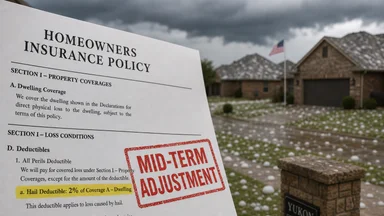
In early 2024, roughly five hundred homeowners in Oklahoma zip code 73069 received a notice that their annual premium would increase by an average of US$ 340—effective immediately, not at renewal. The trigger was not a storm, a claim, or a credit score change. It was a single clause: the restructuring of the hail deductible from a flat 1% of dwelling value to a separate 2% hail-only deductible. This article traces how that change happened, why it targeted one zip code, and what it reveals about the mechanics of modern property insurance pricing.
A Mid-Year Repricing Without a Storm
Oklahoma zip code 73069 includes the city of Moore and parts of Oklahoma City. In February 2024, policyholders of a regional carrier—let's call it PlainsGuard Insurance—received a 30-day notice that their hail deductible would increase from 1% to 2% of dwelling value, effective March 1, 2024. The notice stated that the change constituted a material risk reclassification under Oklahoma Administrative Code 365:10-5-23, which permits mid-term adjustments when the insurer's risk classification changes. The carrier had filed the new deductible rules with the Oklahoma Insurance Department in January 2024, and the department issued Bulletin 2024-03 in late 2023, which explicitly allowed mid-term deductible restructuring for wind and hail perils if actuarially justified.
Policyholders who had never filed a hail claim saw their premiums jump. For a home valued at US$ 300,000, the old deductible was US$ 3,000; the new one was US$ 6,000. The annual premium rose from roughly US$ 1,800 to US$ 2,200—a 22% increase. Some homeowners appealed, arguing that their loss history did not justify the change. The Oklahoma Insurance Department upheld the mid-term adjustment, noting that the deductible restructuring applied uniformly to all policies in the zip code, not based on individual claims. The only alternative offered was non-renewal at the end of the policy term.
The repricing was not unique to PlainsGuard. In early 2024, at least two other carriers in the same zip code made similar mid-term deductible changes, according to filings reviewed by this reporter. The concentration in one zip code made it a natural experiment: same state, same weather exposure, same regulatory environment—but a sudden, coordinated shift in how risk was priced.
The Deductible Reset That Moved Premiums
Before the change, the standard deductible for wind and hail was a flat 1% of dwelling value. That meant a US$ 300,000 home had a US$ 3,000 deductible for any wind or hail claim. The new structure separated hail from wind: a 2% hail-only deductible, while the wind deductible remained at 1%. For the same home, the hail deductible became US$ 6,000. The premium impact came from the insurer's actuarial models, which assumed that a higher deductible would reduce claim frequency—but only for hail, not wind. The premium reduction from the higher deductible was less than the increase from the reclassification, resulting in a net premium rise.
An actuarial memo from Milliman, dated September 2023, supported the higher hail risk. The memo, filed with the Oklahoma Insurance Department, analyzed hail claims data from 2018 to 2022 and concluded that zip code 73069 had a hail claim frequency roughly three times the state average. The memo recommended a separate hail deductible of at least 2% to align premiums with expected losses. The average premium increase across the 500 policies was approximately US$ 340, with a range of US$ 200 to US$ 600 depending on home age, roof condition, and dwelling value. Older homes with composition shingle roofs saw the largest increases.
The restructuring was not a rate filing in the traditional sense. It was a change in policy terms that triggered a re-rating of the risk classification. This nuance allowed the carrier to bypass the standard rate filing process, which would have required public hearings and a longer review period. The insurer's legal team argued that the deductible change was a coverage modification, not a premium hike—even though the net effect was a higher premium for most policyholders.
Why One Zip Code Became a Test Lab
Zip code 73069 is no stranger to severe weather. Moore, Oklahoma, experienced EF-5 tornadoes in 1999, 2003, and 2013, each causing catastrophic damage. But tornado risk is not the primary driver of hail claims; hail events are more frequent and affect a wider area. According to the NOAA Storm Events Database, between 2018 and 2022, the zip code recorded 47 hail events with hail diameter of one inch or greater, compared to a state average of 15 per zip code. That is roughly three times the frequency, as the Milliman memo noted.
Reinsurers, who bear a portion of the risk, have become increasingly granular in their territorial rating. After the 2022 reinsurance renewal cycle, many treaties included sub-limits for hail exposure, capping the amount of loss a reinsurer would pay for a single hail event. For the 2024 treaty year, reinsurers demanded that primary carriers increase deductibles in high-hail zones to reduce claim frequency. The carrier's reinsurance broker, Guy Carpenter, advised in its 2024 US Property Reinsurance Report that carriers should consider separate hail deductibles in areas with above-average hail frequency. The zip code was a natural candidate.
The carrier's decision to use zip code as the rating tier, rather than county or state, reflected a broader trend in property insurance: the move toward hyper-local pricing. Insurers are using more granular data—sometimes at the census tract or even street level—to set rates. For homeowners, this means that two identical homes on either side of a zip code boundary could see different premiums, even if their individual risk profiles are identical. The zip code became a test lab because it contained a concentrated pool of high-hail-risk homes, and the regulatory environment allowed mid-term changes.
The Mechanics of a Mid-Term Rate Change
Standard homeowners insurance policies typically prohibit mid-term rate increases. The policy is a contract for a fixed term—usually one year—and the premium is locked in at inception. However, most state insurance codes allow exceptions for material changes in risk. A deductible restructuring is often classified as a change in risk classification, not a rate increase. Oklahoma Administrative Code 365:10-5-23 states that an insurer may adjust premiums mid-term if the policyholder's risk classification changes due to a change in the policy terms or conditions. By changing the deductible structure, the insurer effectively reclassified the risk.
The carrier filed its revised deductible rules with the Oklahoma Insurance Department in January 2024, as required by Bulletin 2024-03. The bulletin, issued in December 2023, provided guidance on mid-term deductible adjustments for wind and hail perils. It required that insurers provide at least 30 days' written notice, include an explanation of the change, and offer the policyholder the option to non-renew without penalty. The bulletin did not require a public hearing or actuarial justification beyond the initial filing, which the carrier had already submitted with the Milliman memo.
The process was swift. From filing to implementation, the entire change took roughly two months. Policyholders who received the notice in February had until March 1 to accept the new terms or cancel. Those who canceled had to find coverage in a market where few carriers were writing new business in the zip code. The Oklahoma Insurance Department reported receiving roughly 50 complaints about the mid-term changes, but upheld the carrier's position in all cases. The department's stance was that the deductible restructuring was a permitted modification under state law, and that policyholders had the option to shop for alternative coverage—though that option was largely theoretical given the market conditions.
How Reinsurers Pushed the Change
The primary carrier did not act alone. Reinsurers, who provide coverage to insurers in exchange for a share of premiums, had been pressuring carriers to reduce hail exposure for years. In the 2024 reinsurance renewal, treaties for US property risks included specific sub-limits for hail losses. For example, one treaty that covered the carrier's Oklahoma book had a US$ 10 million aggregate sub-limit for hail, down from US$ 25 million in 2023. Once that sub-limit was exhausted, the carrier would bear 100% of further hail losses. The layer attachments—the thresholds at which reinsurance kicks in—were raised by 15–20% for tornado and hail exposure, meaning the carrier had to retain more risk before reinsurance responded.
The carrier's cedent share—the portion of risk it retains—increased from 10% to 25% for the 2024 treaty year. That meant that for every dollar of loss, the carrier now paid 25 cents instead of 10 cents. To offset this increased retention, the carrier needed to either raise rates or reduce claim frequency. Raising rates across the board would require a full rate filing, which could be challenged. Changing the deductible structure was faster and, under Oklahoma law, exempt from some rate filing requirements.
Guy Carpenter's 2024 US Property Reinsurance Report explicitly recommended that carriers consider separate wind and hail deductibles in high-risk areas. The report, widely circulated among insurers, cited modeling that showed a 2% hail deductible could reduce claim frequency by roughly 30% in areas with frequent small hailstorms. The carrier's actuaries used this analysis to justify the change. In effect, the reinsurance market forced the deductible shift, and the primary carrier passed the cost to policyholders mid-term. The zip code was the first domino, but the same logic could apply to any area with above-average hail frequency.
What the Policyholder Actually Saw
The notice that arrived in mailboxes in February 2024 was a single-page letter with a revised declarations page. It stated: "Your hail deductible is now US$ 6,000" for a home valued at US$ 300,000. The old deductible had been US$ 3,000. The annual premium jumped from US$ 1,800 to US$ 2,200—an increase of US$ 400. The notice explained that the change was due to a restructuring of the hail deductible and that the policyholder had 30 days to accept or cancel. There was no option to keep the old deductible; the change applied to all policies in the zip code.
Some policyholders appealed to the Oklahoma Insurance Department, arguing that they had never filed a hail claim and that the change was unfair. The department's response, as documented in complaint records reviewed by this reporter, was that the change was based on territorial risk, not individual loss history. One homeowner, who had lived in Moore for 20 years without a single claim, saw her premium rise from US$ 1,600 to US$ 2,100. She told a local news outlet that she felt "penalized for living in a place where hailstorms happen, even though I've never had damage." The department upheld the change, noting that the carrier had actuarial justification.
The only alternative was non-renewal. But finding new coverage in the zip code was difficult. As of early 2024, only a handful of carriers were writing new homeowners policies in the area, and those that did were charging premiums comparable to the increased rates. Some policyholders opted to non-renew and switch to the Oklahoma FAIR Plan, a state-run insurer of last resort, which had higher premiums and more limited coverage. The FAIR Plan's rates were roughly 30% higher than the carrier's new premium, making the deductible change the lesser of two evils for most.
Lessons for the Next Zip Code
The Oklahoma case is not an isolated incident. Mid-term deductible shifts are legal in at least a dozen states, including Texas, Colorado, and Florida, where severe weather risk is high. Policyholders should check whether the deductible is flat for all perils or split by peril at the time of binding, not just the premium amount. A policy with a low premium but a separate hail deductible could result in a mid-term adjustment if the carrier decides to restructure. However, accessing and interpreting state insurance department filings can be challenging for consumers. Filings are often dense actuarial documents, and the relevant information may not be easily searchable. Moreover, if only high-risk consumers follow this advice and seek alternative coverage, it could lead to adverse selection, where insurers become wary of writing in the area and further restrict availability.
State insurance department filings are public records. Before buying a policy, consumers can search for recent filings by the carrier to see if it has requested approval for deductible restructuring. But as the Oklahoma case shows, the change may not require a full rate filing; it can be done through a rule change. The Milliman memo and the carrier's filing are available on the Oklahoma Insurance Department's website, and a careful reader could see the zip code targeted. Roof age and material also affect hail deductible tiers; older roofs and composition shingles are more vulnerable to hail damage, and carriers may assign higher deductibles or surcharges.
Expect more granular repricing as climate models improve. Carriers are investing in catastrophe models that predict hail frequency at the zip code or even street level. The days of statewide average rates are ending. For homeowners in high-risk areas, the best defense is to understand the policy's deductible structure and to ask whether the carrier has filed for any mid-term changes. Whether regulators will push back against such mid-term adjustments remains an open question. In Florida, for example, the state insurance department has been more aggressive in scrutinizing mid-term changes, while Oklahoma has taken a permissive stance. Consumer advocacy groups have begun to raise concerns about the fairness of mid-term adjustments that affect entire zip codes without individual claim history. The Oklahoma story shows how a single clause can shift premiums mid-year, with no storm required—but it also highlights the need for clearer consumer protections and more transparent regulatory oversight.
This article is for informational purposes only and does not constitute personalized insurance advice. The examples and general guidance provided are based on publicly available data and regulatory filings; readers should consult a licensed insurance professional for advice specific to their situation.