One 2011 Regulator Rule Lets Banks Keep Overdraft Fees on Authorized Payments

In 2011, the Federal Reserve adopted a small amendment to Regulation E that had an outsized impact on overdraft fees for more than a decade. The rule required banks to obtain a customer's affirmative consent — an opt-in — before charging overdraft fees on ATM withdrawals and one-time debit card transactions. But it left a gaping exception: checks, automated clearing house (ACH) payments, and recurring debit card transactions were not covered. That exception became a blueprint for fee extraction.
The 2011 Rule That Quietly Changed Overdraft Economics
Before 2011, banks could charge overdraft fees on virtually any transaction that caused an account to go negative, regardless of how the transaction was initiated. Consumer advocates had long argued that this practice was predatory, especially for low-income customers who relied on debit cards for daily purchases. The Fed's amendment to Regulation E, effective July 1, 2011, was intended to give consumers a choice: opt in and pay fees for the convenience of having an ATM or debit card transaction go through, or opt out and have the transaction declined at no charge.
The rule applied only to ATM and one-time debit card transactions. For checks, ACH payments, and recurring debit card transactions — such as monthly subscription fees or gym memberships — banks could still charge overdraft fees without obtaining opt-in consent. The Fed reasoned that these payment types were less frequent and more predictable, so consumers could manage them more easily. However, the distinction created an incentive for banks to treat as many transactions as possible as recurring. Banks quickly adapted by reclassifying certain one-time debit card transactions as recurring if the merchant stored the card number for future use — a practice known as card-on-file. A hotel reservation, a car rental deposit, or an online purchase where the consumer saved payment information could be treated as a recurring transaction, even if the consumer had no intention of buying again. Because the rule did not define "recurring" with precision, banks had wide latitude to interpret it.
The result was a shift in fee revenue. Between 2011 and 2016, the share of overdraft fees coming from authorized-but-pending transactions — transactions that a bank approved in real time but settled later — rose sharply. A 2017 report by the Consumer Financial Protection Bureau (CFPB) found that nearly half of all overdraft fees were triggered by debit card transactions that the bank had authorized when the account had a positive balance, only to charge a fee when the transaction settled days later.
How Banks Classify Authorized Payments to Maximize Fees
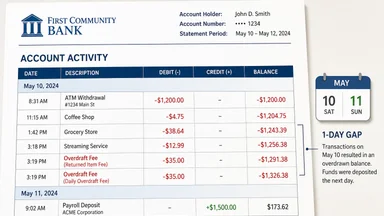
The mechanics of an authorized-payment overdraft fee are a study in timing. When a consumer swipes a debit card at a restaurant, the merchant sends an authorization request to the bank. The bank checks the account balance, and if funds are available, it places a temporary hold on the amount. At that point, the bank has authorized the transaction. But the actual settlement — the movement of money from the consumer's account to the merchant's — can take one to three business days.
If the consumer makes additional purchases or writes checks during that gap, the available balance may drop below the hold amount. When the settlement finally arrives, the account is negative, and the bank charges an overdraft fee — even though the account had enough funds at the moment of authorization. For example, Wells Fargo's account agreement states that the bank may charge an overdraft fee on a transaction that was authorized when the account had a positive balance, if the settlement later causes a negative balance. This practice is explicitly permitted under the bank's terms. Some banks charge the fee at the moment of authorization itself, treating the hold as a completed debit. The consumer sees the fee on their statement before the transaction has even cleared.
The problem is compounded when multiple authorizations are pending simultaneously. A consumer who buys groceries, fills a gas tank, and pays for a parking garage on the same day may have three separate holds on their account. If any one of those holds causes the available balance to dip below zero, the bank may charge a fee for each subsequent transaction, even if the total of all holds is less than the account balance. This cascading effect can produce several fees from a single day of ordinary spending.
Banks defend the practice by arguing that the authorization hold creates a real obligation: the bank must set aside funds and cannot use them for other purposes. They say the fee compensates for the risk that the account will be negative when the settlement occurs. But consumer advocates counter that the bank has already decided to approve the transaction at the point of sale, and the fee punishes the consumer for a timing mismatch that the bank controls.
Industry data suggests the scale of the problem. A 2022 study by the Pew Charitable Trusts found that consumers who incurred one overdraft fee on an authorized payment were likely to incur multiple fees within the same billing cycle. The median fee amount was $34, and roughly 9 percent of checking account holders paid more than 10 fees per year. For those consumers, the fees often exceeded the original transaction amounts.
The Consumer Financial Protection Bureau's Failed Fix Attempts
The CFPB first drew attention to the authorized-payment loophole in a 2017 report titled "Data Point: Checking Account Overdraft." The report documented that 26 percent of overdraft fees were triggered by debit card transactions that had been authorized when the account had a positive balance. The Bureau suggested that the opt-in rule had not worked as intended, because banks had simply shifted fee-generating activity to the exempt categories.
In 2022, the CFPB proposed a new rule to close the loophole. The proposal would have required banks to treat all debit card transactions — including recurring and card-on-file payments — as subject to the opt-in requirement. It also would have prohibited banks from charging overdraft fees on transactions that were authorized when the account had sufficient funds, regardless of whether the settlement later caused a negative balance. The banking industry responded with intense lobbying, arguing that the rule would reduce consumer choice and force banks to raise other fees.
The rulemaking stalled. By 2024, the CFPB had not issued a final rule, and the political climate had shifted. A 2025 CFPB guidance document reiterated the Bureau's view that authorized-payment fees could be unfair and deceptive under the Dodd-Frank Act, but the guidance lacked enforcement teeth. Most large banks continued the practice unchanged. As of mid-2026, no federal regulation explicitly prohibits charging an overdraft fee on a transaction that was authorized with a positive balance.
The Bureau's difficulty reflects a deeper structural challenge. The 2011 rule was designed to give consumers a choice, but it assumed that banks would honor the spirit of the opt-in requirement. Instead, banks found ways to keep the fees flowing while complying with the letter of the rule. Closing the loophole would require either a new rulemaking with a clear definition of "recurring" or a legislative change to the Electronic Fund Transfer Act itself. Neither has materialized.
Who Profits: The Top 10 Banks' Fee Windfall
The financial incentive to maintain the status quo is enormous. JPMorgan Chase reported roughly $2.3 billion in overdraft and nonsufficient-funds fees for the 2025 fiscal year, according to its annual filing. Wells Fargo reported about $1.8 billion, and Bank of America about $1.2 billion. These figures represent a slight decline from peaks in the mid-2010s, due in part to voluntary fee reductions some banks adopted under political pressure, but the totals remain substantial.
Mid-size and regional banks rely even more heavily on overdraft fee income. Regions Financial, based in Birmingham, Alabama, generated roughly 9 percent of its retail banking revenue from overdraft fees in 2025. For smaller community banks, the percentage can exceed 15 percent. The authorized-payment segment is the fastest-growing part of this fee revenue, because it applies to everyday debit card swipes that consumers do not think of as risky.
The economics are straightforward: overdraft fees have near-zero marginal cost. The bank's cost to process an authorization hold and later settle it is a fraction of a cent. A $35 fee, multiplied by tens of millions of transactions per year, yields billions in profit. Unlike interest income, which depends on lending margins, fee income is pure margin. This makes it attractive even for banks that otherwise compete on low interest rates or high savings yields.
Shareholder reports and investor presentations confirm the priority. In earnings calls, bank executives often cite "overdraft fee optimization" as a driver of non-interest income. Some banks have introduced "courtesy pay" programs that automatically opt customers into overdraft coverage on all transaction types, including authorized payments, unless the customer explicitly declines. The default setting, unsurprisingly, leads to higher opt-in rates.
The geographic distribution of fee income is uneven. A 2024 analysis by the Center for Responsible Lending found that overdraft fees disproportionately affect households in the South and Midwest, where lower median incomes and higher transaction volumes combine to produce more frequent overdrafts. In states like Mississippi and Arkansas, the average overdraft fee per account was roughly double that in Massachusetts or Washington.
The Fine Print: How Disclosure Documents Obscure the Rule
If the mechanics of authorized-payment fees are complex, the disclosures that banks provide to consumers are deliberately opaque. The standard checking account agreement runs 50 to 80 pages, with fee schedules buried in appendices. The section on overdraft services typically describes the opt-in requirement for ATM and one-time debit transactions but then refers to a separate "Recurring Debit Card Transactions" policy that is not prominently highlighted.
Banks define "recurring" broadly. Many account agreements state that any transaction where the merchant has stored the card number for future use qualifies as recurring, regardless of whether the consumer intends to make another purchase. This includes hotel authorizations, car rental deposits, and online shopping checkouts where the consumer checked a "remember this card" box. A consumer who opts out of overdraft on one-time debit transactions may still be charged fees on these authorized payments without realizing it.
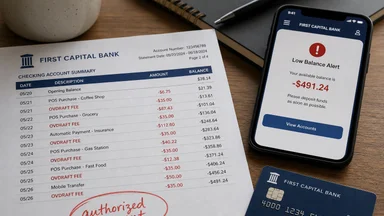
The Schumer box — the standardized disclosure of checking account fees required by federal regulation — shows only the standard overdraft fee amount and the opt-in language. It does not require banks to itemize how many fees were charged on authorized versus settled transactions. A consumer reviewing their monthly statement sees a line item "Overdraft Fee" but cannot tell whether it was triggered by a pending hold or a final debit.
Consumer testing by the CFPB in 2021 found that most account holders did not understand that a transaction could be authorized with sufficient funds and still incur a fee later. When shown sample statements, participants consistently assumed that a fee would only apply if the account was negative at the time of the transaction. The disconnect between consumer understanding and bank practice is a feature, not a bug, of the disclosure system.
Some banks have made minor improvements. A few now send real-time alerts when an overdraft fee is charged, and some offer a grace period to deposit funds before the fee is assessed. But these are voluntary measures, and they do not address the core issue: the rule itself allows fees on authorized payments, and the disclosures do not make that clear.
Practical Steps to Avoid the Authorized-Payment Trap
For consumers who want to avoid authorized-payment overdraft fees, the most effective step is to opt out of overdraft coverage entirely. Under Regulation E, banks must allow customers to withdraw their opt-in consent at any time. Once opted out, any transaction that would overdraw the account is simply declined — no fee, no hold, no settlement surprise. This applies to ATM and one-time debit transactions. For checks and ACH, opting out does not prevent the fee, but those payment types are less frequent and easier to monitor.
A second strategy is to use a debit card only when the account balance is comfortably positive, and to check the available balance — not just the current balance — before making a purchase. Many banks display the available balance in mobile apps, but it often includes pending holds. A consumer who sees a balance of $500 but has a $100 restaurant hold from two days ago may have only $400 available. Ignoring the hold can lead to an overdraft on the next transaction.
Setting up low-balance alerts is a low-cost way to stay informed. Most banks allow customers to receive a text or email when the account balance falls below a threshold, such as $100. The alert can prompt a transfer from savings before an overdraft occurs. Linking a checking account to a savings account for automatic overdraft protection is another option, though some banks charge a transfer fee — typically $10 to $12 — which is cheaper than a $35 overdraft fee but still an expense.
For recurring payments — gym memberships, streaming services, insurance premiums — switching to a credit card can eliminate the risk of an authorized-payment overdraft. Credit card transactions do not pull from a checking account, so there is no hold to cause a fee. The credit card bill can be paid in full each month to avoid interest. This also builds a payment history, which can improve credit scores over time.
Finally, consumers should review their account agreement for the bank's specific definition of "recurring" and check their monthly statements for any overdraft fees. If a fee appears, it is worth calling the bank to ask for a reversal. Some banks will waive the first fee as a courtesy, especially for customers who have not had a fee in the past 12 months. Persistence can pay off, but the burden remains on the consumer to police a system designed to extract money.
Why Reform Stalls Despite Bipartisan Criticism
Overdraft fees have attracted criticism from both ends of the political spectrum. Consumer advocates on the left argue that the fees are predatory and disproportionately harm low-income households. Free-market conservatives have joined the criticism, arguing that the fees distort competition by allowing banks to hide the true cost of checking accounts behind opaque fee structures. Yet reform has repeatedly stalled.
From the banking industry's perspective, overdraft fees are a legitimate price for a service: the convenience of having a transaction go through rather than being declined. Banks argue that these fees allow them to offer free checking accounts to millions of customers who would otherwise face monthly maintenance fees. They also contend that the opt-in rule already gives consumers a choice, and that those who opt in do so because they value the ability to complete a transaction even when their balance is low. According to the American Bankers Association, overdraft fees represent a transparent pricing mechanism that allows banks to cover the costs of processing transactions and managing risk. Without such fees, banks would need to raise other charges or reduce services for all customers.
The banking industry's lobbying power is a major factor in the stalemate. In 2025, the American Bankers Association and other trade groups spent roughly $70 million on federal lobbying related to consumer finance issues, according to disclosure filings. The industry has successfully argued that any restriction on overdraft fees would reduce access to banking for low-income customers, who may rely on overdraft coverage as a form of short-term credit.
Legislative efforts have faltered. A Senate bill introduced in 2024, numbered S. 1234, would have required banks to obtain opt-in consent for all overdraft fees, including those on checks and ACH, and would have prohibited fees on authorized payments. The bill was referred to the Banking Committee but never received a hearing. A companion bill in the House met a similar fate. Neither bill had bipartisan co-sponsorship, and the committee chairs did not prioritize them.
The CFPB's rulemaking process is slow and subject to political winds. The Bureau's director serves a five-year term, but directors from one administration may be replaced by the next. As of mid-2026, the CFPB had not finalized any rule specifically targeting authorized-payment fees, and its guidance was nonbinding. State-level efforts to cap overdraft fees have been partly preempted by federal law, which limits state authority over national banks.
Consumer advocacy groups, while vocal, have struggled to unify around a single legislative or regulatory ask. Some push for a complete ban on overdraft fees; others advocate for a cap of $5 per transaction; still others focus on disclosure reform. Without a clear, common goal, the industry has been able to divide and delay. The result is a regulatory stalemate that benefits the banks and leaves consumers to navigate a system that was designed, however inadvertently, to generate fees from ordinary spending.
This article is for informational purposes only and does not constitute legal, financial, or professional advice. Readers should consult with a qualified professional for advice tailored to their individual circumstances.