A Florida Homeowners Policy Paid a German Reinsurer at a Brazilian Index

When a Florida homeowner pays a premium to Citizens Property Insurance Corporation, that dollar begins a journey through a global web of reinsurance contracts, catastrophe bonds, and cross-border retrocession agreements. The money may eventually settle in a Brazilian reinsurer's trust account, with recoveries tied to an inflation index that has nothing to do with hurricanes. This article traces that path and examines the regulatory gaps, basis risks, and hidden leverage that emerge when property insurance becomes a vehicle for international capital market arbitrage.
The Florida Homeowners Policy That Traveled to Munich Re
Citizens Property Insurance, Florida's state-backed insurer of last resort, writes roughly 1.2 million policies as of late 2024, covering homes that private carriers decline to insure. Under Florida law, Citizens must cede a portion of its risk to the private market through its Depopulation program and through quota share reinsurance treaties. In practice, Citizens cedes about 65% of its exposure to a panel of roughly 50 reinsurers, including Munich Re, Swiss Re, and others. The remaining 35% stays on Citizens' books, funded by policyholder assessments and a potential surcharge on all Florida property insurance policies if Citizens' surplus is depleted.
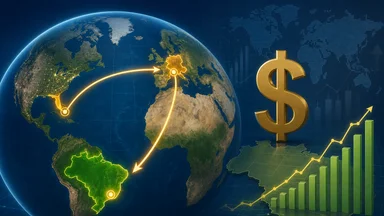
Munich Re, a German reinsurer, receives a premium from Citizens for assuming a share of Florida hurricane risk. Munich Re then retrocedes part of that risk to IRB Brasil RE, the largest Brazilian reinsurer. The retrocession contract is denominated in U.S. dollars, but IRB Brasil RE's recoverables are ultimately subject to Brazilian regulatory and economic conditions. When a hurricane strikes Florida, the loss flows from the homeowner to Citizens, to Munich Re, to IRB Brasil RE—and the settlement may depend on the Brazilian real exchange rate. The retrocession agreement typically includes a currency clause that allows the Brazilian reinsurer to pay in reais at the prevailing exchange rate, but the primary reinsurer (Munich Re) must then convert to dollars, exposing it to currency fluctuation.
No single regulator sees the full chain. Florida's Office of Insurance Regulation (OIR) audits Citizens and its licensed reinsurers, but retrocessionaires like IRB Brasil RE are not directly licensed in Florida. The Brazilian insurance regulator SUSEP oversees IRB's solvency under local rules, while Germany's BaFin monitors Munich Re. The gaps in oversight create opacity that the 2007 Financial Stability Oversight Council report flagged as systemic risk in the property catastrophe market. A more recent 2023 report by the International Association of Insurance Supervisors (IAIS) reiterated concerns about the concentration of retrocession risk in a handful of global reinsurers, noting that a simultaneous shock could propagate through multiple jurisdictions before regulators can respond.
Consider a concrete scenario: In 2017, Hurricane Irma caused roughly $30 billion in insured losses in Florida. Citizens ceded a portion to Munich Re, which in turn had retroceded a layer to IRB Brasil RE. IRB Brasil RE's trust account, invested in Brazilian government bonds, suffered a mark-to-market loss as Brazilian interest rates rose during the same period. IRB had to post additional collateral to Munich Re, which in turn had to post additional collateral to Citizens. The collateral calls created a liquidity squeeze that was resolved only after the Brazilian central bank intervened to stabilize the bond market. This episode illustrates how a natural catastrophe in Florida can transmit financial stress to an emerging market sovereign bond market—a channel that few risk models capture.
How a Florida Cat Bond Tracks the IPCA
In 2023, the World Bank's International Bank for Reconstruction and Development (IBRD) issued a catastrophe bond covering Florida hurricane risk. The bond pays a coupon to investors—many of them Brazilian pension funds and U.S. money managers—that is indexed to the Brazilian IPCA inflation index. If a qualifying hurricane causes losses above a trigger threshold, principal is at risk. But the coupon payment's real value depends on Brazilian inflation, not on Florida storm frequency.
The structure creates an arbitrage: Brazilian pension funds seek inflation-linked returns, while U.S. investors want hurricane risk exposure uncorrelated with equity markets. The World Bank swaps the inflation exposure via a cross-currency swap, effectively converting the IPCA-linked coupon into a fixed U.S. dollar payment. But the hedge introduces counterparty risk and basis risk—if the swap counterparty defaults or if IPCA diverges from the inflation implicit in the swap pricing, the economics shift. For example, if Brazilian inflation runs at 10% but the swap was priced assuming 6%, the World Bank must absorb the difference, reducing its fee income. This basis risk is typically borne by the World Bank, not the bond investors, but it affects the cost of future issuances.
The loss trigger is based on a U.S. storm model (e.g., RMS or AIR), not on Brazilian data. So the bond's payout depends on Florida hurricane intensity, but its funding cost depends on Brazilian inflation. This mismatch is not disclosed in typical offering memoranda, which focus on storm risk. Investors who buy the bond for its catastrophe exposure may not fully appreciate the inflation linkage embedded in the coupon. A 2024 survey by the Insurance-Linked Securities (ILS) market association found that only about 30% of institutional investors in cat bonds fully understand the index basis risk in their portfolios. The rest rely on ratings and simplified risk summaries.
Another example: In 2021, a smaller cat bond referencing Florida wind risk used a Mexican inflation index (INPC) for coupon adjustments. The bond performed well during a quiet hurricane season, but when Mexican inflation spiked to 8% in 2022, the coupon payment increased unexpectedly, benefiting investors. However, the issuer—a Bermuda-based special-purpose vehicle—had to pay more than anticipated, reducing the arbitrage profit. Such index mismatches are more common than disclosed; the ILS market has issued roughly $15 billion in bonds with non-U.S. inflation linkages since 2015, according to a 2023 study by the Geneva Association.
The Brazilian Reinsurer That Underwrites Miami Condos
IRB Brasil RE assumed roughly $500 million in Florida homeowners quota share treaties as of 2024, according to analyst estimates. The Brazilian reinsurer prices U.S. wind exposure using local models that may not capture the same tail risk as Florida-licensed models. Because IRB is not licensed in Florida, it must post collateral—typically 100% of gross liabilities—in a U.S. trust account. That collateral is held in U.S. dollars but invested in Brazilian sovereign bonds, which yield roughly 12% as of late 2024 versus 5% for U.S. Treasuries. The yield pickup is attractive, but it introduces a mismatch: the collateral's value depends on Brazilian interest rates, which are volatile and can spike during a crisis.
The collateral investment strategy creates a yield pickup for IRB, but it also introduces basis risk: the Brazilian bond yield is unrelated to Florida hurricane loss. If a hurricane depletes the trust, IRB must replace the collateral. The cost of replacing that collateral depends on Brazilian interest rates at the time, which could be higher or lower. For instance, during the 2020 COVID-19 crisis, Brazilian interest rates dropped to 2% as the central bank cut rates, making collateral replacement cheaper. But in 2022, rates rose to 13.75% as inflation surged, making replacement expensive. A reinsurer that had to post new collateral in 2022 would face a much higher cost than one that did so in 2020. This timing risk is not hedged because long-dated interest rate swaps for Brazilian reais are illiquid beyond five years.
Solvency II and NAIC RBC treat the same risk differently: Solvency II gives credit for collateral held in OECD jurisdictions, while NAIC RBC applies a 100% charge for unlicensed reinsurers regardless of collateral quality. This regulatory asymmetry encourages Brazilian reinsurers to write U.S. risk via Bermuda or London intermediaries, further lengthening the chain. The U.S. Treasury's Federal Insurance Office has noted that such structures can concentrate risk in lightly regulated jurisdictions, but no binding action has been taken. A 2022 proposal by the NAIC to require disclosure of retrocession counterparties was met with industry opposition and has not been adopted.
Consider the case of a Miami condo association that buys a policy from Citizens. Citizens cedes to Munich Re, which retrocedes to IRB Brasil RE. IRB's trust account holds $100 million in Brazilian sovereign bonds. If a hurricane causes $50 million in losses, IRB must sell bonds to pay Munich Re. But if Brazilian bond prices have fallen (e.g., due to political uncertainty), IRB may have to sell more bonds than expected, potentially triggering a liquidity crisis. The condo association is unaware of this chain, but its claim payment depends on IRB's ability to liquidate assets in a stressed market. This is not a hypothetical: in 2018, a smaller Brazilian reinsurer, J Malucelli, defaulted on a retrocession obligation to a European reinsurer after a Brazilian bond sell-off, causing a cascading dispute that took two years to resolve in arbitration.
Why Florida Regulators Cannot Track the Premium Dollar
Citizens cedes to more than 50 reinsurers globally, and those reinsurers retrocede to hundreds of retrocessionaires. Some retrocession towers exceed ten layers. There is no centralized repository of cession data; each contract is privately negotiated. Florida OIR audits only direct writers and licensed reinsurers, not the full chain. Unlicensed retrocessionaires—many of them special-purpose vehicles in the Cayman Islands or Bermuda—escape state oversight entirely. The 2007 FSOC report on property catastrophe reinsurance noted that "the opacity of retrocession chains makes it difficult for regulators to assess systemic exposure." The report recommended enhanced reporting, but the industry resisted, citing proprietary concerns. As a result, a Florida regulator cannot trace the premium dollar from a Miami condo to a Brazilian retrocessionaire without a subpoena. In practice, only the lead reinsurer knows the full downstream exposure.
This opacity matters when a major hurricane hits. In 2022, Hurricane Ian caused roughly $60 billion in insured losses, and some reinsurers disputed recoverables because of ambiguous contract language around aggregate limits. If a Brazilian retrocessionaire fails to pay, the loss flows back up the chain to Citizens, which may then impose assessments on all Florida policyholders. The policyholder who paid the premium never sees the chain, but bears the ultimate risk. A 2023 study by the Florida Insurance Consumer Advocate estimated that a 10% default rate on retrocession recoveries would trigger an average assessment of $150 per policyholder across the state. That cost is invisible until it materializes.
One proposed solution is a mandatory central clearinghouse for reinsurance contracts, similar to the Depository Trust & Clearing Corporation for securities. The NAIC has explored this idea but faces legal hurdles: reinsurance contracts are considered private commercial agreements, and forcing disclosure could face constitutional challenges under the Commerce Clause. Moreover, reinsurers argue that revealing downstream exposures would harm their competitive position. The trade-off between transparency and proprietary information is a perennial tension in insurance regulation.
What a Brazilian Index Tells Us About US Climate Risk
The IPCA index reflects Brazilian consumption patterns—food, housing, transport—not U.S. hurricane frequency. Yet reinsurers use index-linked structures to reduce capital charges under Solvency II and NAIC RBC. By tying recoverables to an index, the contract qualifies as a derivative rather than a reinsurance treaty, which may lower the capital requirement. This regulatory treatment is controversial: critics argue that index-based contracts do not provide true indemnity and can fail precisely when needed. For example, if a hurricane occurs but Brazilian inflation is low, the index-linked recoverable may be insufficient to cover the loss, leaving the primary insurer with a shortfall. Conversely, if inflation is high, the recoverable may be more than needed, creating a windfall for the reinsurer. This basis risk is often ignored in capital models.
Florida hurricane losses are paid partly in Brazilian real terms because the retrocessionaire's recoverable is denominated in dollars but its capital is in reais. If the real depreciates against the dollar after a hurricane, the Brazilian reinsurer's dollar-denominated liability becomes more expensive in local currency, potentially straining its solvency. This currency risk is rarely hedged because long-dated currency swaps are expensive and illiquid for emerging market pairs. A 2024 paper by the Bank for International Settlements found that only about 20% of emerging market reinsurers hedge their foreign exchange exposure on U.S. liabilities, leaving a significant gap.
U.S. GAAP and IFRS 17 treat reinsurance recoverables differently. Under GAAP, recoverables are measured at the undiscounted amount expected to be collected, with a credit impairment allowance. Under IFRS 17, recoverables are discounted and adjusted for the time value of money and financial risk. A Brazilian retrocessionaire's recoverable may be valued differently on a U.S. primary insurer's books versus its European parent's books, creating arbitrage opportunities and reporting complexity. For instance, a U.S. insurer using GAAP might show a higher recoverable asset than its European affiliate using IFRS 17, even if the underlying contract is identical. This discrepancy can affect solvency ratios and investor perceptions.
Climate models suggest that hurricane frequency and severity will increase in the coming decades, which could correlate with Brazilian inflation if global commodity prices rise after storms. Some analysts argue that the index mismatch creates hidden leverage: if both hurricane losses and Brazilian inflation spike simultaneously, the cost of recovering from a Brazilian retrocessionaire could rise sharply. The 2024 IPCC report notes that tropical cyclone intensity is projected to increase, but the link to Brazilian domestic inflation is speculative. However, a 2023 study by the World Bank found that major hurricanes in the Atlantic tend to increase food prices in emerging markets due to supply chain disruptions, which could feed into Brazilian inflation. If that correlation strengthens, the basis risk in index-linked cat bonds could become more pronounced.
The Practical Takeaway for Risk Managers
Risk managers at primary insurers should map their full reinsurance chain to every jurisdiction, including retrocessionaires and special-purpose vehicles. Request collateral investment policies from alien reinsurers to understand how trust assets are deployed. Stress-test recoverables under non-U.S. inflation scenarios, particularly if the retrocessionaire is domiciled in an emerging market. Demand transparency on index triggers and basis risk in any insurance-linked security that references an unrelated index. A simple stress test: assume Brazilian inflation rises to 15% while a Category 5 hurricane hits Miami. How much would the recoverable be worth in real terms? If the answer is less than the expected loss, the risk is not properly hedged.
Consider currency overlay hedges for long-tail liabilities, though these hedges are costly and imperfect. For example, a five-year currency swap between USD and BRL might cost 3-4% per year in premium, eating into the arbitrage gain. Push state regulators like Florida OIR to enhance reporting on retrocession counterparties, perhaps through a central database accessible to all state insurance departments. The National Association of Insurance Commissioners has discussed such a database, but progress has been slow. In the meantime, risk managers must rely on their own due diligence. Some large insurers have built proprietary databases of retrocession exposures by aggregating broker data, but smaller insurers lack the resources to do so.
Finally, understand that the premium dollar does not stop at the state line. It crosses borders, currencies, and regulatory regimes, and it may return to pay a claim only after passing through a Brazilian index. The system works most of the time, but when it fails, the cost falls on the policyholder who bought a simple homeowners policy in Florida. A 2024 report by the Florida Senate Banking and Insurance Committee recommended that Citizens enhance its own due diligence on retrocessionaires, including requiring quarterly collateral reports and independent audits of trust accounts. Whether these recommendations will be implemented remains to be seen, but the risk is real and growing.
Disclaimer: This article is for informational purposes only and does not constitute professional insurance, legal, or financial advice. Readers should consult qualified professionals for advice tailored to their specific circumstances.