One Crop Reinsurance Contract Priced Corn in Iowa and Wheat in France by the Same Soil Moisture Index

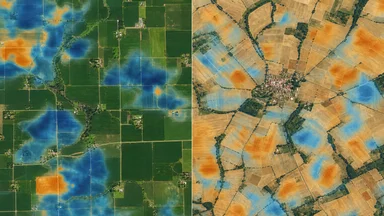
A single satellite-derived soil moisture index priced parametric reinsurance for Iowa corn and French wheat in 2025. No field adjuster visited either continent. No loss adjuster measured a stalk or a grain head. The contract paid out automatically when the index fell below the 40th percentile of the 20-year historical record, regardless of whether the cause was drought in the U.S. Midwest or persistent rain in the French countryside. This index, produced by the European Space Agency (ESA) and EUMETSAT, and validated under the U.S. National Oceanic and Atmospheric Administration's (NOAA) Soil Moisture Operational Product System (SMOPS), priced two fundamentally different crops, two regulatory regimes, and two climate patterns as one risk pool.
One Index, Two Continents, Different Risks
The soil moisture index measures the water content in the top 30 centimeters of soil using microwave radiometry from polar-orbiting satellites. For Iowa corn, moisture deficit during July and August—the critical pollination window—directly correlates with yield loss. For French wheat, the same index captures both drought stress during spring growth and excess moisture during harvest, which can cause lodging and fungal damage. The index does not distinguish between these mechanisms; it simply reports a number.
Loss curves diverge sharply between the two regions. In Iowa, a soil moisture reading at the 30th percentile historically corresponds to roughly a 15% yield reduction. In France, the same reading might produce a 10% reduction for wheat, but a reading at the 70th percentile—indicating wet soil—can trigger a comparable loss due to waterlogging and disease. The contract treats the index symmetrically, paying out when moisture falls below the 40th percentile. This means French wheat carries a lower probability of payout from drought but a non-zero probability from the opposite tail, which the index does not capture.
Reinsurers price the correlation between the two regions differently. Some models assume a zero correlation between Iowa July drought and French June rainfall; others assign a modest positive correlation based on large-scale atmospheric patterns like the jet stream. The difference in correlation assumptions can swing the contract's expected loss by 15–20%, which directly affects the premium the reinsurer charges the primary insurer.
How a Single Reinsurance Contract Covers Both
The contract is a parametric reinsurance layer, meaning it pays a fixed amount when the index triggers, regardless of actual losses. The trigger is set at the 40th percentile of the 20-year historical soil moisture record, with a payout of $50 per acre for corn and €40 per hectare for wheat, adjusted by a currency exchange rate lock. No field inspection is needed. The primary insurer—a mutual in Iowa and a cooperative in France—cedes 70–80% of the risk to the reinsurer, who aggregates the two portfolios into a single book.
Iowa drought risk dominates the combined loss cost. Historical data from the U.S. Department of Agriculture shows that severe drought events in Iowa occur roughly once every 7–10 years, with loss ratios (claims divided by premiums) exceeding 100% in those years. French wheat, by contrast, experiences more frequent but less severe moisture events: excess rain in 2023 and 2024 pushed loss ratios to around 120% and 90%, respectively, according to estimates from the French agricultural insurance association.
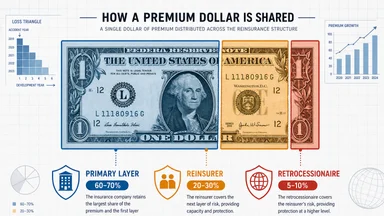
The premium is split according to historical volatility. Iowa corn accounts for roughly 60% of the combined premium, reflecting its higher payout probability and larger per-acre exposure. French wheat makes up the remaining 40%, but its volatility is higher on a year-to-year basis, which the reinsurer must hold additional capital against under Solvency II. The contract's annual premium is recalculated using a five-year rolling average of the index, with a 10% margin for the reinsurer's cost of capital.
Premium Flow: From Farmer to Retrocessionaire
A typical Iowa corn farmer pays roughly $15–$25 per acre for a multi-peril crop insurance policy, of which the federal government subsidizes about 60%. The private insurer retains a small portion—typically 20–30%—and cedes the rest to a reinsurer. For the parametric soil moisture layer, the farmer pays an additional $5–$8 per acre, which flows entirely to the reinsurer. In France, the farmer pays roughly €10–€15 per hectare for a similar parametric add-on, with no government subsidy, so the premium is fully earned by the reinsurer.
The reinsurer, in turn, may retrocede 30–50% of the risk to the capital markets through a catastrophe bond. In the second quarter of 2026, the catastrophe bond market set new issuance records, with sponsors including agricultural reinsurers. One such bond, issued by a special-purpose vehicle, references the same soil moisture index and pays a coupon of 8–10% above LIBOR. Investors—pension funds, hedge funds, and dedicated ILS funds—absorb the peak risk, typically the layer above a 1-in-15-year loss.
The premium flow diagram is straightforward but opaque. The farmer pays the primary insurer, who deducts a ceding commission (typically 10–15% of the ceded premium) and passes the rest to the reinsurer. The reinsurer deducts its own margin and retrocession costs, then transfers the residual to the cat bond trust. The investor receives the premium minus fees, plus the return of principal if no trigger occurs. In 2025, the combined premium for the Iowa-France contract was roughly $12 million, of which about $4 million flowed to cat bond investors.
Regulatory Friction: US vs. EU Frameworks
The contract must satisfy two regulatory regimes. In the US, crop insurance is regulated by the Risk Management Agency (RMA), which approves policy forms and rates. The parametric add-on must comply with the Federal Crop Insurance Act, which requires that the index have a demonstrable correlation to yield loss. The RMA also mandates a 35% loss cost ratio floor, meaning the premium cannot be so high that the expected loss ratio falls below 35%. This limits the reinsurer's ability to charge for basis risk or capital costs. Specifically, the RMA's Standard Reinsurance Agreement (SRA) requires that any parametric product be actuarially sound, with a loss cost ratio between 35% and 100% for the underlying book. The RMA also reviews the index's historical performance against actual yield data from the National Agricultural Statistics Service (NASS) over at least 15 years.
In the EU, Solvency II imposes a capital charge for basis risk. The reinsurer must hold additional capital equal to the difference between the 99.5% value-at-risk of actual losses and the 99.5% VaR of index-based payouts. For the French portion, this capital charge is roughly 15–20% of the premium, according to industry estimates. The reinsurer passes this cost back to the primary insurer in the form of a higher premium loading. Additionally, the European Insurance and Occupational Pensions Authority (EIOPA) has issued guidelines on the use of external data for underwriting, requiring that the index be independently validated and that the basis risk be quantified using a stress-testing framework.
France's mutual insurers dominate the crop insurance market, accounting for roughly 70% of premiums. These mutuals are less capital-efficient than stock insurers because they hold reserves collectively and cannot easily access capital markets. As a result, the parametric contract is more attractive to French mutuals as a way to offload tail risk without tying up capital. In Iowa, private insurers with federal reinsurance backstop have less incentive to use parametric products, but the simplicity of the index appeals to those seeking to reduce administrative costs.
The cross-border contract faces double compliance costs. The reinsurer must file the contract with the RMA in the US and with the Autorité de Contrôle Prudentiel et de Résolution (ACPR) in France. Each regulator requires separate actuarial memoranda, legal opinions, and solvency calculations. The total compliance cost for the 2025 contract was roughly $200,000, or about 1.7% of the premium—a non-trivial drag on profitability. Moreover, the two regulators have different timelines: the RMA requires filing 90 days before the start of the crop year, while the ACPR requires 120 days. This mismatch forces the reinsurer to begin the compliance process nearly six months in advance, locking in terms before the latest weather data is available.
Loss Experience Diverges by Climate Regime
In 2023, a severe drought in Iowa pushed the soil moisture index below the 40th percentile for 12 consecutive weeks. The parametric contract paid out roughly $85 per insured acre, resulting in a loss ratio of approximately 85% for the Iowa portion. That same year, French wheat experienced a wet spring but the index remained above the trigger, so no payout occurred. The combined loss ratio was roughly 50%, giving the reinsurer a healthy margin.
In 2024, the pattern reversed. French wheat suffered from persistent rain during harvest, with some regions reporting a 30% yield drop. The soil moisture index, however, remained above the 40th percentile because the satellite measured high moisture content—but the trigger only pays when moisture falls below the threshold. The contract did not pay out, even though actual losses were severe. The French cooperative filed a dispute, arguing that the index failed to capture excess moisture risk. The reinsurer's response: the contract language is clear, and the index was designed for drought, not flood. The loss ratio for the French portion was 0%, but the cooperative's overall portfolio loss ratio was 120%, forcing it to draw on its own reserves.
These divergent outcomes highlight the asymmetry of the index. The contract protects against drought, but not against excess moisture, even though the same index can measure both. Reinsurers adjust regional loading factors to account for this: the French premium includes a 15% load for the risk that the index fails to capture wet-year losses, while the Iowa premium includes a 5% load for the same reason. The 2024 experience led to a renegotiation of the French loading factor for the 2026 contract cycle.
The US property/casualty industry as a whole posted its best combined ratio in a decade in 2025, driven partly by favorable crop insurance results. But the divergence in loss experience between the two regions underscores the challenge of a one-size-fits-all index. Reinsurers are now exploring separate sub-indices for the two crops, though the administrative cost of splitting the contract may outweigh the benefits.
Basis Risk: The Hidden Cost of Standardization
Basis risk is the difference between the index trigger and the farmer's actual loss. For the Iowa-France contract, the gap can reach 15% of the insured value, according to a 2024 study by the University of Nebraska-Lincoln. In Iowa, sandy soils amplify basis risk because they drain faster than the satellite sees, leading to false negatives—the index stays above the trigger while the farmer experiences loss. In France, fragmented fields—some on clay, some on loam—create spatial basis risk, where the satellite pixel averages across soil types and masks local conditions. The index provider—a collaboration between ESA and NASA—publishes a daily soil moisture map with a resolution of 10 kilometers. But the contract uses a weekly average over a 25-kilometer pixel to reduce noise. This smoothing reduces the frequency of false triggers but increases basis risk for farmers whose fields are smaller than the pixel. In France, where the average field size is about 30 hectares, a single pixel can cover 50 or more fields, each with different drainage and crop stage. The contract's basis risk is therefore higher in France than in Iowa, where fields are larger and more uniform.
Reinsurers charge a 5–10% load on the premium to compensate for this risk. But the load is uniform across all insureds, meaning a farmer on sandy soil in Iowa effectively subsidizes a farmer on clay in France. This cross-subsidy is invisible to the primary insurer, who passes the cost through to the farmer as a flat fee. Some farmers have hedged their basis risk by buying put options on the same soil moisture index, traded on the Chicago Mercantile Exchange. The options cost roughly 2–3% of the insured value and pay out when the index falls below a secondary trigger, covering the gap between the index and actual loss. However, this option market is thin—only a few thousand contracts trade daily—so liquidity risk adds another layer of cost.
Some reinsurers have proposed splitting the contract into regional sub-indices, each with its own trigger and payout schedule. But the primary insurers resist, because a single index simplifies administration and reduces the cost of data validation. The trade-off between simplicity and accuracy is at the heart of the basis risk debate, and there is no clear resolution.
To illustrate the basis risk more concretely, consider a corn farmer in Iowa's Marshall County, where soils are predominantly sandy loam. In the severe drought of 2023, the farmer's actual yield loss was about 18%, but the index only triggered a payout corresponding to a 12% loss—a gap of 6 percentage points. Conversely, a wheat farmer in France's Eure-et-Loir region, with clay soils, experienced a 10% yield loss from waterlogging in 2024, but the index did not trigger at all. The farmer received zero payout despite a real loss. These examples show that basis risk is not merely a theoretical concern but a tangible financial hit that varies by farm and year.
What the Next Contract Cycle Looks Like
The 2026 contract cycle is already under negotiation, and the shape of the next iteration is becoming clear. The two-region index is likely to be split into separate sub-indices for Iowa corn and French wheat, each with its own trigger and payout curve. The French contract will add a precipitation floor—a second trigger that pays out when cumulative rainfall during May and June exceeds the 80th percentile. The Iowa contract will weight July dryness more heavily, using a 60-day moving average during the pollination window.
Reinsurers are demanding layer-specific pricing, meaning the premium for the first 10% of loss will be higher than for the layer above a 1-in-20-year event. This reflects the growing sophistication of catastrophe models, which now incorporate soil moisture data alongside traditional weather station records. Guy Carpenter's recent health reinsurance hires in Latin America signal a broader trend toward specialized risk analytics, but the agricultural reinsurance market remains relatively standardized.
Cross-market standardization is still elusive. The US and EU regulatory frameworks differ too much for a single contract to satisfy both without costly adaptations. Some reinsurers are pushing for a global soil moisture index that would cover all major grain-producing regions, but the political and technical hurdles are immense. Can the 2025 Iowa-France contract serve as a template for scale, or is it a one-off experiment? The answer depends on whether the regulators can harmonize their approval processes and whether the basis risk can be reduced to acceptable levels through better index design.
The next contract cycle will likely retain the parametric structure but with more granular triggers, higher basis risk loads, and separate capital charges for each region. The premium will increase by an estimated 10–15% to reflect the lessons of 2024. Farmers will pay more, but they will also get a product that better aligns payout with actual loss. Whether that trade-off is worth it depends on the farmer's risk tolerance, soil type, and faith in satellite data.
Disclaimer: This article is for informational purposes only and does not constitute professional insurance, investment, or legal advice. The contract details described are illustrative and based on a composite of industry practices, not a specific real-world contract. Readers should consult qualified professionals for advice tailored to their specific circumstances.