A Small Town’s Zoning Code Forces Every New Home into a Single Price Tier

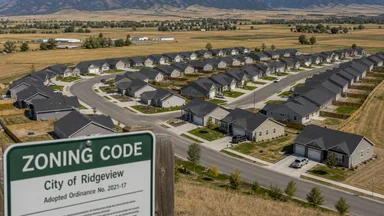
In a small Montana county, a zoning code intended to create orderly growth has instead flattened the housing market into a single price tier. Every new home built under the ordinance must fall within a narrow price band, roughly US$400,000 to $500,000 as of late 2024. Starter homes under $300,000 are prohibited. Luxury homes over $600,000 are also barred. The result is a market that serves almost no one well—first-time buyers are locked out, move-up buyers find no options, and builders operate with margins so thin that many have simply stopped building.
The Zoning Trap That Flattens Choice
The code, adopted in 2019 after a contentious series of planning commission meetings, requires that at least 80 percent of lots in any new subdivision be developed with homes priced between 90 and 110 percent of the county's median home price. That median, calculated annually, has hovered near $450,000. In practice, this means every new home must be priced within a roughly $90,000 band.
Local builder Mark Tinsley described the bind in an interview with a regional business journal. “We can’t build a $280,000 home for a young couple, and we can’t build a $700,000 home for someone who wants more land. We’re stuck in the middle, and the middle is a very crowded space.” Tinsley’s company has shifted to renovations and additions on existing homes, which are exempt from the code.
The rule was sold as a way to prevent sprawl and ensure “workforce housing,” but critics argue it has done the opposite. By eliminating the low end of the market, the code forces entry-level buyers to compete for older, often dilapidated homes that do not meet modern building standards. Meanwhile, buyers who can afford more are pushed to adjacent counties, driving up prices there.
Data from the county assessor’s office shows that new home permits dropped by roughly 40 percent in the three years after the code took effect. Builders report that they are unable to achieve the required price point without sacrificing quality, and many have turned to speculative building only to see homes sit on the market for months.
How One Town’s Rule Became a National Cautionary Tale
The Urban Institute featured the county’s zoning code in a 2025 report on regulatory barriers to housing affordability. The report noted that the single-price-tier requirement was “unusual in its rigidity” and had produced “unintended consequences that should inform other jurisdictions considering similar approaches.”
Young families have been hit especially hard. The county’s population of residents aged 25–34 declined by roughly 8 percent between 2020 and 2025, according to census estimates. A local real estate agent told a state newspaper that she had watched half a dozen young couples leave for neighboring counties where homes cost $50,000 to $100,000 less.
The median home price in the county is now roughly $450,000, but the median household income is about $62,000. Using a standard 28 percent debt-to-income ratio, a family at that income can afford a home priced around $210,000—less than half the median. The gap between incomes and prices has widened every year since the code was enacted.
Builders have responded by lobbying the county commission to amend the code, so far without success. A 2024 ballot measure to repeal the ordinance was defeated by a narrow margin after a well-funded campaign by supporters who argued that the code preserved “rural character.”
Mortgage Math Under a Uniform Price Floor
For a buyer trying to enter the market, the uniform price floor creates a steep down payment hurdle. A home priced at $450,000 requires a 20 percent down payment of $90,000—a sum that would take a median-income household more than a decade to save at a 10 percent savings rate. FHA loans, which allow as little as 3.5 percent down, are available only for homes that meet FHA appraisal guidelines, and the $450,000 price point is near the FHA loan limit for the area, leaving little room for negotiation.
Equity buildup also suffers. In a normal market, a buyer who purchases a starter home at $250,000 and upgrades after five years builds equity through appreciation and principal paydown. In this market, the only homes available are at the top of the buyer’s budget, so equity growth depends almost entirely on appreciation. If the market softens, the buyer could be underwater quickly.
Refinance options are limited by the narrow price band. Appraisals tend to cluster around the median, so a home that was purchased for $460,000 might appraise for only $440,000 a year later, making a cash-out refinance difficult. Lenders are wary of making loans in a market where the resale pool is shallow and prices are artificially pinned.
An analysis by a local credit union found that the average loan-to-value ratio on new mortgages in the county was 92 percent in 2024, compared with 78 percent in the surrounding region. That means buyers are putting down less equity and carrying more debt, increasing their risk of default if rates rise or incomes fall.
Supply Side: Why Builders Can’t Adjust
Builders face a straightjacket of complementary rules. Lot sizes are fixed by the zoning code at a minimum of 8,000 square feet, which makes it impossible to build smaller, cheaper homes even if the price tier were relaxed. The square footage minimum for a new home is 1,800 square feet, eliminating the possibility of a compact, affordable design.
Profit margins are dictated by the single tier. A builder who constructs a home for $400,000 in total costs—including land, materials, labor, and financing—can sell it for roughly $450,000, yielding a 12.5 percent margin. That is thin compared with the 20 to 25 percent margins typical in less-restricted markets. Builders report that any cost overrun, such as a lumber price spike, can erase the profit entirely.
There is no incentive to build affordable units. The code does not include density bonuses or tax abatements for homes priced below the tier. A builder who wanted to construct a $300,000 home would need to apply for a variance, a process that can take months and cost thousands in legal fees. Few have attempted it.
As a result, the county’s housing stock is aging. The median age of a home in the county is now 35 years, compared with 28 years statewide. New construction has shifted almost entirely to custom homes on existing lots, which are exempt from the code but account for fewer than 50 permits per year.
The Unintended Consequence: A Rental Spillover
With homeownership out of reach for many, demand has spilled into the rental market. Rents in the county have risen by roughly 20 percent since 2020, according to a local property management firm. The average two-bedroom apartment now rents for about $1,600 per month, up from $1,300 five years ago.
Investors have taken note. Institutional buyers, including a corporate landlord that owns over 200 single-family homes in the county, have snapped up homes that fall within the price tier, converting them to rentals. The share of homes owned by entities with more than 10 properties has risen from 8 percent in 2019 to 16 percent in 2025, according to county tax records.
Local tenants face a double squeeze: rising rents and stagnant wages. A household earning the median income of $62,000 can afford a rent of roughly $1,450 per month using the standard 30 percent threshold. The average rent now exceeds that amount, leaving many families cost-burdened.
A 2025 survey by a nonprofit housing coalition found that 42 percent of renters in the county reported spending more than half their income on housing, up from 28 percent in 2019. The same survey found that the number of eviction filings had increased by 35 percent over the same period.
What Other Towns Can Learn from This Experiment
The Montana county’s experience offers a cautionary case for municipalities considering price-tier zoning. Inclusionary zoning, which requires a percentage of units to be affordable but allows market-rate flexibility, has produced more balanced outcomes in communities that have adopted it. A study of inclusionary zoning programs in California found that they increased the supply of affordable units without suppressing overall construction.
Form-based codes, which regulate building form and placement rather than price, offer another alternative. These codes allow a mix of housing types—townhouses, duplexes, small-lot single-family—within the same neighborhood, giving builders the flexibility to serve different income levels. A town in Oregon that switched from price-based to form-based rules saw new home construction rise by 25 percent within two years.
A state preemption bill proposed in 2025 would have barred local governments from adopting price-tier zoning of the kind used in the Montana county. The bill failed in committee after opposition from home-rule advocates, but similar measures have been introduced in other states. The debate pits local control against the need for housing variety.
Data from Oregon, which has a statewide land-use planning system, shows mixed results. While the state’s urban growth boundaries have constrained sprawl, they have also contributed to rising home prices. The lesson may be that no single regulatory tool works in isolation; price restrictions must be paired with supply-side measures such as density bonuses and streamlined permitting.
Practical Steps for Homebuyers in a Uniform Market
For buyers stuck in a market like this one, the first step is to look for homes that are exempt from the code. Older homes built before 2019 are not subject to the price tier, and they often sell for less than the mandated range. A 2024 analysis by a local real estate board found that homes built before 2000 sold for an average of $320,000—roughly 30 percent below the new-home median.
Renovation loans, such as the FHA 203(k) or Fannie Mae HomeStyle, can bridge the gap between the purchase price and the cost of upgrades. A buyer who purchases a $320,000 older home and puts $50,000 into renovations may end up with a home worth $450,000, effectively creating equity through sweat equity and smart financing.
Partnering with local housing advocates can help. Nonprofits in the county have formed a housing task force that meets monthly to discuss policy changes and share resources. Buyers who attend these meetings can learn about upcoming variance applications, lot auctions, and first-time buyer programs that are not widely advertised.
Monitoring zoning board meetings is essential. The county commission is required to hold public hearings on any proposed changes to the code. Buyers who show up and speak—or submit written comments—can influence decisions that may eventually loosen the price tier. In 2025, a group of residents successfully pushed for an amendment that allows a small number of lots to be set aside for “missing middle” housing, though the impact has been minimal so far.
Finally, consider whether the uniform market is the right place to buy at all. If the code is unlikely to change and the math does not work, renting or buying in a neighboring county may be the more rational financial decision. The sunk cost of a home that does not appreciate or that strains the budget is far greater than the cost of commuting.
Trade-Offs and Counter-Arguments: Could This Code Ever Work?
Not every analysis of the Montana county’s code is uniformly negative. Some planning advocates argue that the code’s intent—to prevent extreme price stratification and maintain a middle-income community—is laudable. In many fast-growing regions, market forces alone produce a bifurcated housing stock: high-end luxury homes on one end and dilapidated rentals on the other, with little in between. A single price tier, in theory, could preserve a core of moderate-priced homes for teachers, nurses, and retail managers.
Yet the evidence from this county suggests that the rigidity of the rule undermines that goal. A more flexible approach might involve a price band that adjusts annually with a cost-of-living index, rather than a fixed percentage of median price. For example, a code could require that 30 percent of new units be priced below the area median income (AMI) threshold, 40 percent at market rate, and 30 percent unrestricted. That would create a ladder rather than a single rung.
Another counter-argument comes from environmental advocates who support the code’s anti-sprawl effects. By concentrating new construction in a narrow price range, the code may discourage large-lot exurban development that consumes open space and increases vehicle miles traveled. However, the drop in building permits suggests that the code has not reduced sprawl—it has simply shifted development to neighboring counties, which may have weaker environmental protections.
A third perspective is that the code might work in a community with a different economic baseline. If the median income were higher relative to home prices, the mandated price band would align with what many families could afford. In the Montana county, the median home price is roughly 7.3 times the median income, far above the traditional guideline of 3 to 4 times income. In a place like a wealthy suburb of Denver or Seattle, where incomes are higher, the same ratio might produce a band that includes starter homes. But in this rural county, the ratio is simply too stretched.
Finally, some builders privately admit that the code has forced them to innovate. To hit the $450,000 price point, they have adopted cost-saving construction techniques, such as panelized walls and standardized floor plans, that might otherwise have been ignored. If those techniques become standard practice, future building could be more efficient. But that benefit is cold comfort to the families who have been priced out.
How Other States Are Addressing the Problem
Several states have moved to preempt local price-tier zoning of the kind used in the Montana county. In 2023, Texas passed a law prohibiting municipalities from imposing price controls on new homes, though it exempts inclusionary zoning programs that offer incentives. A similar bill in Colorado failed in 2024 but is expected to be reintroduced. The National Association of Home Builders has lobbied for a federal standard that would bar price floors in local zoning, arguing that they violate the Fifth Amendment’s takings clause by depriving landowners of the economic use of their property.
At the local level, some jurisdictions have experimented with “density bonus” programs that allow builders to exceed lot-size and height limits if they set aside a portion of units at below-market prices. For example, a city in Colorado offers a 20 percent density bonus for projects that include at least 10 percent of units priced for households earning 60 percent of AMI. That approach preserves flexibility while still achieving affordability goals.
The Montana county’s experience also highlights the importance of periodic review. The code includes no sunset clause or mandatory impact assessment. A requirement to revisit the ordinance every five years, with public hearings and data analysis, could catch unintended consequences early. Some planning experts recommend that any price-tier regulation include a “circuit breaker” that suspends the rule if building permits fall below a certain threshold for two consecutive years.
Lessons for Policymakers: Avoiding the Single-Tier Trap
For local officials considering similar rules, the Montana case offers several concrete takeaways. First, tie price bands to income rather than median home price. A band set at 80 to 120 percent of area median income (AMI) would automatically adjust as wages change, rather than chasing a housing price index that may spiral upward. Second, include exemptions for accessory dwelling units (ADUs) and tiny homes, which can serve as entry-level housing without requiring large lots. Third, pair price restrictions with supply-side incentives, such as reduced impact fees or expedited permitting for projects that include a mix of price points.
Fourth, conduct a housing needs assessment before adopting any price-tier rule. The Montana county did not model the effect on builder margins or buyer demographics before enacting the code. A simple pro forma analysis would have shown that the required price point was unattainable for many builders given local land and labor costs. Fifth, consider a pilot program that applies the rule to a single zoning district before scaling countywide. That would allow for adjustments based on real-world outcomes.
Finally, engage builders and real estate agents in the drafting process. The Montana code was written primarily by planning staff and citizen volunteers with little input from the construction industry. As a result, the code overlooked practical constraints like lot size minimums and square footage requirements that made compliance nearly impossible. A collaborative process might have produced a more workable rule.
This article is for informational purposes only and does not constitute personalized financial, legal, or real estate advice. Consult a qualified professional for advice tailored to your situation.