The Single Premium Dollar That Paid a Primary Layer, a Reinsurer, and a Retrocessionaire

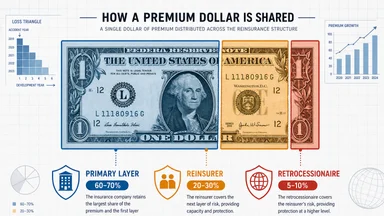
When a mid-sized manufacturer buys a $50 million general liability policy, the premium dollar it pays does not stay with one carrier. Instead, that dollar is carved into slices that fund a primary layer, a reinsurer, and a retrocessionaire—each pricing risk using different data, models, and margin expectations. Understanding that flow explains why premiums move the way they do, and why a single dollar of premium is never really one dollar.
One Dollar, Three Hands: The Anatomy of a Premium Dollar
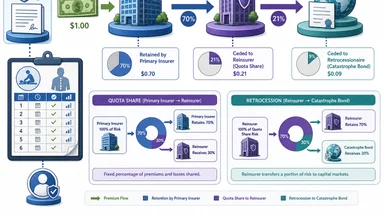
Of every premium dollar written on a typical large general liability account, the primary carrier retains roughly 60–70 cents. The remaining 30–40 cents is ceded to a reinsurer, which in turn may pass 5–10 cents to a retrocessionaire. Another 5–10 cents goes to broker commission and overhead, and a small residual covers loss-adjustment expenses. This layered structure exists because no single carrier wants to bear the full tail risk of a large liability claim.
The primary carrier's retained portion funds the first layer of coverage—typically the first $10 million to $25 million of any single loss. Above that attachment point, the reinsurer steps in, covering the next $25 million or $30 million. The retrocessionaire sits at the top, absorbing the most remote but potentially largest losses. Each layer's pricing reflects its risk profile: the primary layer has higher frequency but lower severity, while the retrocession layer has very low frequency but extreme severity.
Broker commission is deducted upfront, often as a percentage of the total premium. In a typical large account, the broker may take 5–10 cents of each dollar. Overhead—underwriting salaries, systems, rent—consumes another few cents. Loss-adjustment expenses, such as legal fees and expert costs, are usually allocated pro rata across layers when a claim occurs, but they are funded from the premium pool as well.
This split is not static. In a soft market, primary carriers may retain more risk to win business, ceding a smaller share. In a hard market, reinsurance becomes more expensive, and primary carriers may raise rates to cover higher cession costs. The retrocession layer, being the most volatile, can swing 20–40% year-on-year in price, directly affecting the reinsurer's cost and, ultimately, the insured's premium.
Pricing the Primary Layer: From Loss Pick to Loaded Rate
Primary carriers begin pricing by constructing loss triangles—historical claim data organized by accident year and development period. These triangles show how losses emerge over time, from initial reporting through final settlement. For general liability, claims can take five to ten years to fully develop, so actuaries must project ultimate losses using paid and incurred loss data.
Next, a trend factor is applied to account for inflation in claim costs. For general liability, this trend typically runs 3–5% annually, driven by rising medical costs, higher jury awards, and increased litigation expenses. The trend factor compounds over the expected life of the policy, so a policy written today may see claims settled five years from now at significantly higher amounts.
Expense load covers the carrier's underwriting, claims handling, and overhead. This load is usually expressed as a percentage of premium, often in the range of 25–35% for primary carriers. Profit margin targets add another 5–8%, though in competitive markets margins can compress to 2–3% or even turn negative. The combined ratio—the sum of loss ratio and expense ratio—must stay below 100% for underwriting profit.
Competitive pressure in soft markets pushes carriers to lower their loss picks and compress margins. For example, in 2022, the NAIC reported an average combined ratio of 102% for general liability, meaning the industry lost money on underwriting. Carriers that aggressively cut rates to gain market share often face adverse development later, as loss picks prove inadequate. A counter-argument exists: some carriers argue that lower loss picks are justified by improved risk selection and better claims management. However, the long-tail nature of general liability makes it difficult to verify these claims until years later.
Ceded Premium: How the Reinsurer Prices Its Slice
The reinsurer evaluates the portfolio of risks ceded to it, looking for correlation across policies. A single large loss from a manufacturing plant explosion could trigger multiple policy layers, so the reinsurer models aggregate exposure using stochastic simulations. Rating agency capital models, such as those from A.M. Best or S&P, set attachment points that ensure the reinsurer maintains sufficient capital to withstand a 1-in-200-year loss.
For emerging lines like cyber liability, catastrophe models from RMS or AIR are used to price the tail risk. These models simulate thousands of scenarios—ransomware attacks, data breaches, cloud outages—to estimate the probability of extreme losses. The reinsurer's margin on ceded premium typically ranges from 10% to 15%, though this can rise in hard markets. Reinsurers also consider the diversification benefit of writing multiple lines, which can reduce the overall risk charge.
The ceding carrier receives a commission from the reinsurer to offset acquisition costs. This commission, often 15–20% of the ceded premium, helps the primary carrier cover broker fees and underwriting expenses. The commission structure creates an incentive for the primary carrier to cede more premium in soft markets, as the commission can improve its net income even if the underlying business is marginally profitable. However, this can lead to moral hazard: the primary carrier may underwrite less carefully if it knows a large portion of the risk is transferred.
Reinsurers also impose aggregate limits and exclusion clauses to control their exposure. For example, a reinsurer may exclude losses from a specific manufacturing process or cap coverage for certain jurisdictions. These terms directly affect the price of the ceded premium and the primary carrier's ability to offer broad coverage. In practice, negotiations over exclusions can be as important as the premium itself.
Trade-off: A primary carrier can choose a quota share treaty, where the reinsurer takes a fixed percentage of every policy, or an excess of loss treaty, which only attaches above a threshold. Quota share provides more predictable ceded premium but less protection against large losses. Excess of loss is cheaper in normal years but can be expensive after a catastrophe. Carriers often blend both structures to balance cost and risk.
Retrocession: The Invisible Final Layer
Retrocessionaires take the topmost slice of a reinsurer's catastrophe-exposed book. Because the probability of a loss reaching this layer is very low—perhaps once in 50 or 100 years—pricing relies on ultra-long-term loss data and sophisticated tail-risk models. The retrocessionaire must hold capital that could be tied up for decades, so its return expectations are high.
Market capacity in the retrocession layer is limited. After large loss events, such as Hurricane Katrina or the 2008 financial crisis, retro capacity shrinks dramatically as capital flees the market. Premiums can spike 20–40% year-on-year as a result. The Bermuda and London markets, including Lloyd's syndicates, dominate this layer, providing roughly 60–70% of global retrocession capacity. Newer players, such as insurance-linked securities (ILS) funds, have entered the space, offering alternative capital that can stabilize pricing but also introduce new sources of volatility.
Retrocessionaires often use sidecars—special-purpose vehicles that allow investors to take on a slice of risk for a fixed term—to access capacity without tying up permanent capital. These sidecars are priced based on the expected loss and a risk premium, and they can be structured to cover a specific peril or a blended portfolio. The sidecar market has grown significantly, with annual issuance reaching roughly $10–15 billion globally in recent years, according to industry estimates.
The retrocession layer is invisible to the insured, but its price volatility can ripple down to the primary premium. When retro rates rise, reinsurers pass the cost to primary carriers through higher ceded premiums, and those carriers in turn raise rates for insureds. Understanding this chain helps buyers anticipate market cycles. For example, after the 2017 hurricane season, retrocession rates doubled, and primary commercial property rates followed with increases of 10–20% within a year.
The Claim That Tests Every Layer: a $50 Million General Liability Scenario
Consider a $50 million general liability policy with a $10 million primary retention, a $30 million excess layer, and a $10 million retrocession layer. A manufacturing defect leads to a product liability claim that settles for $50 million after a three-year litigation. The primary carrier pays the first $10 million, covering defense costs and the settlement within its retention.
Above $10 million, the reinsurer steps in, paying the next $30 million. The reinsurer's exposure is capped at $30 million, but its loss-adjustment expenses—legal fees, expert witnesses—are allocated pro rata. If total defense costs are $5 million, the reinsurer pays 30/50 of that, or $3 million, in addition to the $30 million indemnity.
The retrocessionaire covers the final $10 million above $40 million. Its exposure is the most remote, but it also bears a share of defense costs. In this scenario, the retrocessionaire pays $2 million in allocated expenses. The total claim cost to the retrocessionaire is $12 million, which may exceed its premium for that account by a wide margin.
Timing matters. The primary carrier pays defense costs as they arise, while the reinsurer and retrocessionaire reimburse periodically, often quarterly. Disputes over coverage allocation can delay payments and increase legal costs. The entire process may take two to five years, during which the carriers hold reserves that tie up capital. A counter-argument: some carriers prefer to settle quickly to reduce uncertainty, even if it means paying a slightly higher amount, while others litigate aggressively to set a precedent for future claims.
In a variation of this scenario, if the claim triggers multiple retrocession layers (e.g., two separate retro treaties), the allocation becomes even more complex. Each retrocessionaire may have different terms, and disputes can arise over which layer responds first. Such disputes can lead to arbitration or litigation, adding further costs.
Real-World Anchors: How Actual Carriers Split the Dollar
In 2023, Chubb reported a cession ratio of roughly 22% for its property and casualty book, meaning 22 cents of every premium dollar was ceded to reinsurers. That figure varies by line: D&O and cyber have higher cession ratios, while workers' compensation tends to be retained more. Munich Re's retrocession program covers about 8% of its net premium, reflecting the selective use of retro for peak perils.
Aon's 2023 reinsurance market report noted a 15% increase in retrocession rates, driven by tightening capacity and higher loss expectations. That increase fed into primary rate adequacy, contributing to the hard market in commercial lines. NAIC data for 2022 showed an average combined ratio of 102% for general liability, underscoring that primary carriers were not earning their cost of capital.
These numbers are not precise forecasts, but they illustrate the magnitude of the flows. A small change in the retrocession market can shift primary rates by several percentage points. For example, a 10% increase in retro premium might add 2–3% to the primary rate if fully passed through. However, pass-through is never perfect; primary carriers may absorb some cost to maintain market share, especially in competitive segments.
Another real-world anchor: The 2023 renewal cycle saw retrocession rates for U.S. property catastrophe risk rise by roughly 30–50%, according to broker reports. This fed into primary property insurance, where rates increased by 10–15% for commercial accounts. The same mechanism applies to general liability, though with a longer lag due to the longer tail.
Takeaway for Buyers: Why One Dollar Isn’t One Dollar
For risk managers and insurance buyers, the layered structure means that the premium paid is not simply a reflection of expected claims. It includes the cost of capital for three separate carriers, each with its own return expectations. Reinsurance cost directly affects primary rate adequacy: when reinsurance is cheap, primary carriers can offer lower rates; when it is expensive, rates must rise.
Retrocession tightening is a leading indicator of a hardening market. If retro capacity shrinks and prices spike, primary rates will follow within six to twelve months. Buyers should ask their brokers for details on cession and retrocession structures in their placement—how much of the premium is ceded, to which markets, and at what cost. Some brokers provide a "reinsurance breakdown" that shows the cost of each layer, which can be a valuable negotiation tool.
Understanding that price reflects layered risk transfer, not just claims history, helps buyers evaluate renewal proposals more critically. A rate increase may be justified by rising reinsurance costs even if the insured's own loss experience is favorable. Conversely, a soft market may mask inadequate pricing that will correct later. Buyers should also consider the financial strength of the carriers in each layer; a weak retrocessionaire could fail to pay when needed, leaving the reinsurer and ultimately the insured exposed.
Ultimately, the single premium dollar that leaves the insured's account funds a complex ecosystem of risk transfer. Each layer serves a purpose, but each also adds friction and cost. Recognizing that ecosystem is the first step to becoming a more informed buyer. By asking the right questions and understanding the chain, risk managers can better anticipate market shifts and negotiate more effectively.
This article is for informational purposes only and does not constitute professional insurance, legal, or financial advice. Consult a qualified professional for advice tailored to your specific situation.