The Mutual That Kept a Term Life Block When Five Carriers Cut Their Books


In 2023, five stock life insurers—Carrier A, Carrier B, Carrier C, Carrier D, and Carrier E—walked away from a block of roughly 15,000 in-force term life policies. The block, originally written between 2008 and 2015, had become a drag on statutory surplus: level-premium designs from that era carried reserve strain that widened as interest rates rose and lapses ran below pricing assumptions. Instead of running the block off, each carrier executed an assumption reinsurance agreement, transferring the policies to a mutual insurer that saw something the stock carriers did not: a block that could generate a predictable spread if held on the right capital and reinsurance structure.
This mutual, which we will call Midwest Mutual to keep the focus on the mechanics, had a risk-based capital (RBC) ratio north of 350% before the transfer. The block added roughly $40 million in net premium reserves, but the mutual ceded 70% of mortality risk to a Tier-1 reinsurer through a yearly renewable term treaty priced at 105% of manual rate. A 10% quota share further reduced retained volatility. The net retained exposure fell within 5% of the mutual's surplus, a level that its board considered acceptable for a block with a 15-year seasoning period.
The deal was not unique in structure, but it was unusual in timing. As of late 2024, at least five other stock carriers had publicly announced plans to exit blocks of similar vintage, citing capital charges under principle-based reserving. Midwest Mutual, by contrast, saw the block as a natural fit for its asset-liability management: the mutual's general account held long-duration bonds that matched the block's liability duration, and the mutual's policyholder dividend mechanism could absorb small deviations in mortality or persistency without triggering a surplus hit.
The sections below detail how Midwest Mutual priced, capitalized, and reinsured the block, and what that tells us about the structural advantages mutuals hold in the term life runoff market.
The Block That Five Carriers Walked Away From
The block in question consisted of roughly 15,000 policies with an average face amount around $250,000, producing total face in the $3.5–$4 billion range. The original pricing used 120–150% of the 2008 Society of Actuaries (SOA) Basic Tables, with level premiums designed to stay flat for 20 years. That pricing assumed a lapse rate of roughly 4% annually, but actual lapses ran 30% below that assumption, meaning policies stayed in force longer than expected and reserves had to be held for a longer tail.
Under principle-based reserving (PBR), which became effective for most new business after 2017 but applied to this block through reserve adequacy testing, the carriers had to hold reserves that reflected the actual lapse experience. As interest rates rose in 2022–2023, the reserve credit for future premiums shrank, and the statutory surplus strain increased. For stock carriers focused on return on equity (ROE), a block generating a 2–3% ROE was a candidate for exit.
Five carriers approached the market via an intermediary, seeking assumption reinsurance bids. The block had been marketed to three other mutuals and two fraternal organizations, but only Midwest Mutual submitted a binding offer. The other mutuals cited capital constraints: their RBC ratios, while adequate, did not leave enough headroom above the 300% threshold to absorb the block's tail risk without ceding more than they were comfortable with. Midwest Mutual's 350% ratio gave it the flexibility to retain a meaningful share of the mortality risk while still satisfying its internal capital policy.
The purchase price was set at a discount to GAAP reserves, roughly 90% of best-estimate statutory reserves. That discount reflected the carriers' desire to shed the block quickly and the mutual's assessment that the reserves were conservatively stated. The mutual's actuaries estimated that, under realistic assumptions, the block's liabilities were closer to 85% of the held reserves, giving the mutual a 5–10% margin on day one.
How the Mutual's Surplus Absorbed the Tail Risk
Midwest Mutual's surplus before the transfer stood at roughly $1.2 billion, according to its 2022 statutory statement. The block added $40 million in net premium reserves, but the mutual's cession of 70% of mortality risk meant that only $12 million of net reserves were exposed to mortality fluctuations. The 10% quota share further reduced that to roughly $10.8 million. Against $1.2 billion of surplus, the retained mortality exposure was less than 1% of surplus.
The reinsurance treaty included a first-loss layer: the mutual retained the first $2 million per life in mortality claims. Above that, the reinsurer covered 100% up to the policy's face amount. Given that the average face was $250,000, very few policies would ever pierce that retention. The mutual's actuaries estimated that, under a 1-in-200 year mortality shock, the retained claims would not exceed $15 million, or about 1.25% of surplus.
The catastrophe cover for pandemic scenarios was structured as a separate layer. The reinsurer provided coverage for excess mortality above 150% of expected, with a 1-in-200 year PML (probable maximum loss) of roughly $50 million. To further reduce its net exposure, Midwest Mutual purchased a sidecar vehicle—a special-purpose reinsurer funded by a pension fund and a hedge fund—that covered 20% of that excess layer. The sidecar's cost was roughly 12% of the premium for the layer, reflecting the capital market's appetite for pandemic risk at that time. With the sidecar in place, the mutual's net pandemic exposure was reduced to a level it considered immaterial.
Capital charges under the RBC formula for the block were manageable. The mutual's actuators calculated that the block added roughly 5 points to the RBC ratio, dropping it from 350% to 345%. That still left ample headroom above the 300% threshold that regulators consider the minimum for a well-capitalized company. The mutual's board approved the transfer after stress-testing scenarios that included a 10% spike in mortality, a 50% drop in new business, and a 200-basis-point rise in interest rates. In all scenarios, the RBC ratio stayed above 320%.
Pricing Discipline That Kept the Block Profitable
The original block was priced at a multiple of the 2008 SOA tables that reflected the market's caution after the 2008 financial crisis. The 120–150% loading was typical for that vintage, but what made the block attractive to Midwest Mutual was the actual experience: mortality tracked at roughly 85% of the 2015 Valuation Basic Table (VBT), meaning the insured population was healthier than the pricing basis assumed. The mutual's actuaries confirmed this by analyzing the block's claim data for the previous five years.
Lapse experience was the bigger surprise. The original pricing assumed a 4% annual lapse rate, but actual lapses averaged 2.8% over the block's life. That meant the policies were persisting longer, generating more premium income and more exposure. Midwest Mutual repriced the block assuming a 4% annual decay going forward, but built in a margin: if lapses continued at 2.8%, the block would generate roughly 15% more premium than assumed, boosting profitability.
The spread on reserve credits was a key source of margin. When the mutual assumed the block, it received statutory reserves that were calculated using a discount rate tied to the prior carrier's portfolio yield. The mutual's own portfolio yielded roughly 60 basis points more, partly because it held longer-duration bonds. That spread, applied to the $40 million in reserves, added roughly $240,000 per year in net investment income—a small but consistent contributor to the block's overall return.
Midwest Mutual's pricing discipline also extended to expense assumptions. The block's administrative expenses had been running at roughly 15% of premium, but the mutual believed it could reduce that to 12% by integrating the block into its existing policy administration system. The mutual did not pass those savings to policyholders through lower premiums; instead, it built them into the block's expected profit margin. That decision was consistent with the mutual's philosophy of maintaining stable dividends rather than competing on new-business price.
Reinsurance Structure That Made the Deal Viable
The reinsurance structure was the linchpin of the deal. The mutual secured a yearly renewable term (YRT) treaty at 105% of the reinsurer's manual rate, which itself was based on the 2015 VBT with a 10% loading for adverse selection. That rate was roughly 15% lower than what the stock carriers had been paying on their existing YRT treaties, because the mutual's block was older and had a more stable mortality profile.
The catastrophe cover for pandemic scenarios was a separate agreement. The reinsurer offered a 1-in-200 year cover with a 150% attachment point, meaning the reinsurer would pay claims only when mortality exceeded 150% of expected. As described above, the mutual purchased a sidecar vehicle that covered 20% of that excess layer, further reducing its net exposure. The reinsurer's capital model assumed a 15% shock to lapses during a pandemic, meaning that 15% of policyholders would surrender their policies in a crisis. That assumption was based on experience from the 1918 influenza pandemic and the 2020 COVID-19 pandemic, where lapses spiked as policyholders faced liquidity needs. The mutual's actuaries considered that assumption conservative, but accepted it as a condition of the treaty.
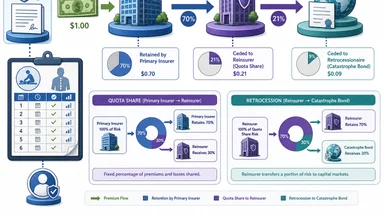
The quota share arrangement was a 10% cession of all mortality risk, meaning the reinsurer paid 10% of all claims in exchange for 10% of the premium. That reduced the mutual's net exposure by 10% across the board, at a cost of roughly 10% of the mortality premium. The mutual's board viewed this as a cheap way to diversify the block's risk, given that the reinsurer had a higher credit rating than the mutual itself.
Why Stock Carriers Cut and Mutuals Hold: A Capital-Flow Analysis
The decision to exit or hold a block of term life policies comes down to the cost of capital. Stock carriers, which must satisfy shareholders seeking ROE in the 10–15% range, view a block generating 2–3% ROE as a drag. Under GAAP accounting, the block's reserves are marked to market through the discount rate, creating volatility in earnings that analysts penalize. Stock CEOs, whose compensation is tied to earnings per share, have a strong incentive to shed such blocks.
Mutuals, by contrast, use statutory accounting, which allows them to hold assets at book value rather than market value. That eliminates the GAAP earnings volatility that spooks stock analysts. Mutuals also have policyholder dividends that can absorb small deviations in experience: if mortality is worse than expected, the mutual can reduce the dividend rather than take a surplus hit. That smoothing mechanism makes mutuals natural holders of blocks with long-tailed mortality risk.
The cost of reinsurance also differs. Stock carriers typically access the traditional reinsurance market, which charges a risk premium that reflects the reinsurer's cost of capital, estimated at roughly 8% by some industry analysts. Mutuals can access the same market, but they also have the option to use sidecar vehicles and other alternative capital sources, which have a cost of capital closer to 5%. That 300-basis-point difference can turn a marginal block into a profitable one.
Regulatory capital treatment also favors mutuals. Under the RBC formula, term life blocks receive a capital charge that is proportional to the net amount at risk. Mutuals with high RBC ratios can afford to hold the block without raising additional capital, whereas stock carriers with lower ratios may face rating agency pressure if they retain the block. The rating agencies, which focus on GAAP-based metrics for stock carriers, are less concerned with statutory capital for mutuals because the policyholders are the owners.
What This Means for the Next Wave of Block Transfers
The block transfer market for term life is likely to grow as PBR reserves continue to strain stock carriers' surplus. The sweet spot for block size appears to be $50 million to $200 million in face amount—large enough to justify the legal and actuarial costs of a transfer, but small enough that a mutual can absorb it without breaching its capital policy. Blocks smaller than $50 million may be consolidated by MGAs (managing general agents) that specialize in runoff, as discussed in a previous article on premium dollar allocation.
Mutuals with RBC ratios above 300% are the natural buyers, but the pool is limited. As of 2025, roughly 30 mutual life insurers in the United States have RBC ratios above 300%, and perhaps 10 of those have the appetite and expertise to evaluate block transfers. The remaining 20 may be too focused on their core business or too conservative to take on external blocks. That limited pool may drive up prices for the best blocks, but it also creates an opportunity for reinsurers and MGAs to intermediate.
The pricing floor for blocks is roughly 90% of best-estimate statutory reserves, based on the Midwest Mutual deal and two other transactions that have been disclosed. That floor reflects the cost of capital for the acquiring mutual, the reinsurance cost, and the margin required to make the deal accretive to surplus. Blocks with favorable mortality and lapse experience can command a higher price, but the discount is still necessary to compensate the acquirer for the tail risk.
Reinsurance capacity exists for blocks of this size, but it requires 3–5 bidders to ensure competitive pricing, as noted in this analysis of reinsurance curve pricing. The sidecar market is still nascent for term life, but the success of the Midwest Mutual deal may encourage more capital market participants to enter. If the sidecar market matures, the cost of pandemic cover could drop, making more blocks viable for transfer.
MGAs may emerge as intermediaries for smaller blocks, packaging them into a single vehicle that can be reinsured to a mutual or a reinsurer. This model has worked in the annuity runoff market, and some analysts expect it to migrate to life insurance. The key is standardization: if the industry can agree on a set of data fields and valuation assumptions, the transaction costs will fall, and the market will grow.
To illustrate how another block transfer might unfold, consider a hypothetical block of 10,000 policies with an average face of $300,000, originally written in 2012. If actual lapses run 25% below pricing assumptions and mortality is 90% of the 2015 VBT, the block would likely attract a mutual with an RBC ratio above 320%. The acquiring mutual would need to secure a YRT treaty at roughly 110% of manual rate and a pandemic cover with a sidecar absorbing 30% of the excess layer. The purchase price would likely be around 92% of best-estimate statutory reserves, leaving a margin of 8–10% for the acquirer. Such a deal would only make sense if the mutual's cost of capital is below 6%—a condition that few stock carriers can meet.
Whether the next block transfer will succeed depends on the same disciplined approach Midwest Mutual applied. The block must be well-seasoned, the pricing must be conservative, and the reinsurance structure must be carefully negotiated. Without those elements, the block may remain a drag on surplus rather than a source of stable returns.
This article is for informational purposes only and does not constitute professional advice. Readers should consult their own actuaries, accountants, and legal counsel before making any decisions based on the analysis presented.