One Escrow Waiver Paragraph That Triples Your Monthly Payment After the First Refinance


You signed a mortgage note with a paragraph that looked like a courtesy. It let you waive the escrow account for property taxes and insurance, shaving maybe $60 off your monthly payment. The lender's closing agent handed you a pen, pointed to the signature line, and said nothing about what would happen when you refinanced. Now, after your first rate-and-term refinance, your monthly payment has jumped by more than the original waiver saved—and nobody at the closing table warned you.
The Escrow Waiver That Reads Like a Free Lunch
The standard Fannie Mae/Freddie Mac uniform instrument includes a provision—often Paragraph 9 of the note—that allows the borrower to waive the lender's requirement to collect monthly escrow payments for taxes and insurance. The waiver is typically a short sentence: "Borrower may waive the escrow requirement by giving Lender written notice." Most homeowners see the lower monthly payment and sign without reading the rest.
What the paragraph does not say is that the waiver is tied to that specific loan, not to you as a borrower. When you refinance, the old loan is paid off and a new loan is originated. The new loan's note contains its own escrow provisions, and unless you negotiate otherwise, the waiver from the old loan does not carry over. The lender for the new loan will require an escrow account—and a catch-up deposit to fund it.
The initial savings are real but modest. For a typical $300,000 mortgage with annual taxes of $3,600 and insurance of $1,200, the monthly escrow contribution is $400. Waiving it saves that $400, but the lender typically adjusts the interest rate or charges a fee to compensate for the added risk. Net savings often land between $50 and $80 per month.
That small monthly break is the bait. The trap springs when you refinance, because the new loan demands a lump-sum deposit to cover the next several months of taxes and insurance—often double what you would have paid if you had kept escrow all along.
Why the First Refinance Triggers a Payment Shock
When you refinance, the old loan is paid off and its escrow account is closed. Any surplus in that account is refunded to you—typically within 20 days under RESPA rules. But the new lender starts fresh. It requires an initial escrow deposit at closing, usually equal to two to three months of property taxes and insurance premiums, plus a cushion of up to one-sixth of the annual disbursements.
For a home with annual taxes and insurance of $6,000, that initial deposit can be $1,500 to $2,500. If you had been making escrow payments all along, that deposit would simply replace the balance you already had. But because you waived escrow, you have no existing balance. The full deposit comes out of your pocket at closing—or, if rolled into the loan balance, increases your principal and monthly payment.
The HUD-1 settlement statement lists this deposit as an itemized cost, but it does not flag it as a consequence of the prior waiver. Borrowers often see the line "Initial Escrow Deposit" and assume it is routine. They do not connect it to the waiver they signed years earlier.
Consumer Financial Protection Bureau complaint data shows a spike in escrow-related complaints following refinance booms. In 2024, complaints about unexpected escrow deposits rose roughly 30% from the previous year, according to a CFPB report. Many borrowers described the deposit as a "surprise" that added hundreds to their closing costs.
The Math They Don't Show You in the Closing Room
Let's run the numbers on a typical scenario. Suppose you bought a home in 2022 with a $350,000 mortgage at 3.5%. Annual taxes are $4,000, insurance $1,500. Monthly escrow would be $458. You waived escrow, saving $458 per month, but the lender increased your rate by 0.25% to compensate—adding roughly $50 to your principal-and-interest payment. Net monthly savings: about $408.
Two years later, in 2024, you refinance to a 6.25% rate. The new loan requires an initial escrow deposit of $2,200 (three months of taxes and insurance plus a cushion). You roll that into the loan balance, increasing principal by $2,200. Your new monthly payment is $2,150—compared to $1,742 if you had never waived escrow and refinanced at the same rate. That is an extra $408 per month, or roughly 23% more.
A Freddie Mac study from early 2025 analyzed refinance transactions in 2024 and found that borrowers who had waived escrow on their original loan faced an average monthly payment increase of 18% beyond what the rate change alone would explain. The study controlled for loan size, credit score, and geographic region.
The net effect: the waiver saved you $408 per month for 24 months—$9,792 total. But the refinance added $408 per month for the life of the new loan, which could be 30 years. Over 28 remaining years, that is over $137,000 in extra payments. The waiver's benefit is a fraction of the cost.
To further illustrate, consider a different scenario with a smaller loan. A borrower in Texas with a $200,000 mortgage at 4.0% waives escrow. Annual taxes are $3,000, insurance $1,000. Monthly escrow would be $333. The lender adjusts the rate by 0.125%, adding about $20 per month to principal and interest. Net monthly savings: roughly $313. After three years, they refinance to a 6.5% rate. The new loan requires an initial escrow deposit of $1,800. Rolled into the loan, that adds about $11 per month to the payment. But the rate increase from 4.0% to 6.5% adds about $300 per month. The total monthly increase is $311, nearly the same as the savings. Over the remaining 27 years, that's over $100,000 in extra payments. The waiver saved $11,268 over three years, but the refinance cost $100,000. The trade-off is stark.
Another example: a borrower in New Jersey with a $500,000 mortgage at 3.0%. Annual taxes are $8,000, insurance $2,000. Monthly escrow would be $833. Waiving saves about $800 per month after rate adjustment. After five years, they refinance to 5.75%. The new escrow deposit is $3,200. Rolled in, it adds $19 per month. The rate increase adds $700 per month. Total increase: $719. The waiver saved $48,000 over five years, but the refinance adds $719 per month for 25 years—$215,700. The waiver's benefit is only 22% of the cost.
How Lenders Engineer the Trap in Loan Documents
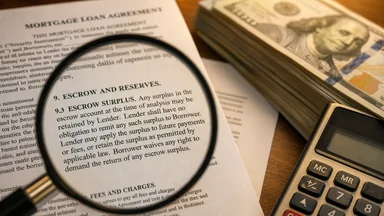
The key language is in Paragraph 9 of the standard Fannie Mae/Freddie Mac note, titled "Escrow Waiver." It states that the lender may require escrow unless the borrower provides written notice waiving it. But it also says: "This Section 9 applies to this Note only. If Borrower refinances this debt, the new lender may require an escrow account."
That second sentence is easy to miss. It is buried in boilerplate, often in the same font size as the rest of the paragraph. No boldface, no all-caps. The borrower signs the note, and the waiver is effective for that loan. But the moment the loan is paid off—through refinance or sale—the waiver evaporates.
Lenders are not required to notify you that the waiver will not survive a refinance. The Truth in Lending Act (TILA) and RESPA mandate disclosures about escrow accounts at origination, but they do not require a warning about future transactions. The closing agent typically does not mention it because they are not your advisor.
Some lenders include a clause that allows them to reinstate escrow if the loan becomes delinquent or if the borrower fails to pay taxes or insurance. That clause is separate from the waiver's expiration upon refinance. Even if you have never missed a payment, refinancing still voids the waiver.
It is worth noting that some borrowers believe the waiver is a permanent feature of their relationship with the lender. They assume that because they have demonstrated responsibility by paying taxes and insurance on time, the waiver will continue. But the contract does not recognize that. The waiver is strictly tied to the note. When the note is paid off, the waiver ends. This misunderstanding is a common thread in consumer complaints.
Real-World Example: A Borrower Who Opted Out Too Early
Consider a homeowner in Phoenix, Arizona, who purchased a home in 2022 with a 30-year fixed mortgage at 3.5%. She waived escrow, reasoning that she could manage the tax and insurance payments herself. Her monthly payment was $1,573, including principal and interest only.
In 2024, with rates still elevated, she refinanced to a 6.25% rate to access equity for home improvements. The new loan required an initial escrow deposit of $2,400. She rolled that into the loan balance, raising her principal by $2,400. Her new monthly payment became $2,150—an increase of $577 per month. Of that, roughly $350 was due to the rate increase, and $227 was due to the escrow deposit amortized over the loan term.
The National Association of Realtors blog cited this case as an example of how escrow waivers can backfire. The borrower later told a reporter she wished she had kept escrow, even though she disliked the monthly deduction. She said the closing agent had told her the waiver was "standard" and "no big deal."
This pattern is not limited to Phoenix. Similar stories appear in borrower complaints across the country, particularly in states with high property taxes like Texas, New Jersey, and Illinois. The dollar amounts vary, but the structure is identical. In Texas, for instance, a homeowner in Houston faced a $3,000 catch-up deposit after refinancing a $250,000 loan. In New Jersey, a homeowner in Bergen County saw a $4,500 deposit. These amounts can be financially crippling for families without significant savings.
Another case from Illinois: a borrower in Chicago waived escrow on a $320,000 loan at 4.25%. After three years, they refinanced to a 6.5% rate. The new escrow deposit was $2,800. The borrower had to borrow from family to cover it. The monthly payment increased by $480, wiping out the $420 monthly savings from the waiver. The borrower later said they would never waive escrow again.
The Only Two Scenarios Where the Waiver Makes Sense
There are situations where an escrow waiver is rational, but they are narrower than most borrowers realize. The first scenario is when you plan to hold the loan past the break-even point—typically five to seven years—without refinancing or selling. If you keep the loan for its full term, the monthly savings accumulate enough to offset the eventual catch-up deposit at payoff.
The second scenario is when you have sufficient liquidity to absorb the lump-sum catch-up without rolling it into the loan balance. If you can write a check for $2,500 at closing without affecting your budget, the waiver's monthly savings are pure gain—as long as you never refinance or sell before the loan matures.
State law can also provide partial protection. California Civil Code Section 2954.1 limits the initial escrow deposit to two months of disbursements, which reduces the catch-up amount. A few other states have similar caps. But even with a cap, the deposit can still be substantial. For example, in California, a home with $6,000 annual taxes and insurance would have a capped deposit of $1,000, which is lower than the $2,000 that might otherwise be required. Still, it is a cost.
For borrowers who expect to move or refinance within five years, the waiver almost always costs more than it saves. The break-even analysis depends on your specific rate, tax rate, and insurance premium, but the general rule is: if you think you might refinance, do not waive escrow. A counter-argument from some financial advisors is that the waiver gives you control over your cash flow and allows you to earn interest on the escrow funds. However, the interest earned on a few thousand dollars is negligible compared to the potential payment shock. Moreover, the risk of missing a tax or insurance payment—and the associated penalties—outweighs any small interest gain.
Three Contract Fixes to Prevent the Payment Shock
If you already have an escrow waiver and are considering a refinance, you have limited options—but you can negotiate. First, ask the new lender to include a clause in the note stating that the escrow waiver from the prior loan will survive the refinance. Most lenders will refuse, but some portfolio lenders (banks that hold loans rather than sell them) may agree. It never hurts to ask.
Second, request an escrow analysis at closing. The lender must provide a projection of the initial deposit and monthly payments. Review it carefully. If the deposit seems high, ask for an itemized breakdown. You can also ask the lender to cap the catch-up deposit at two months of disbursements, even if state law allows more. Some lenders will accommodate this as a courtesy.
Third, hire an independent closing attorney to review Paragraph 9 of the new note. A real estate attorney can spot waiver-related traps and suggest modifications. The cost—typically $300 to $500—is small compared to the potential payment shock. The HUD's RESPA rule also gives you the right to demand written disclosure of all escrow terms before closing.
For borrowers who have not yet signed an escrow waiver, the simplest fix is to decline it. Keep the escrow account. The monthly deduction is automatic, and you avoid the risk entirely. If you prefer to manage your own tax and insurance payments, set aside the equivalent amount in a separate savings account each month. That way, you have the funds ready when the bills come due—and you avoid the refinance trap.
Another strategy is to negotiate a lower interest rate in exchange for keeping escrow. Some lenders offer a rate discount of 0.125% to 0.25% when you agree to escrow. That discount can offset the inconvenience of monthly escrow payments. It is worth asking about.
Related reading: One Regional Lender's Escrow Surplus Clause shows how lenders profit from escrow balances even without a waiver. And How a Brokerage's Order Routing Fee Skims Your Trade illustrates a similar hidden cost in a different market.
This article is for informational purposes only and does not constitute legal, tax, or financial advice. Consult a qualified professional before making decisions about mortgage escrow accounts or refinancing.