One 1996 IRS Tech Rollout Cost 14,000 Freelancers Their Self-Employment Tax Credits

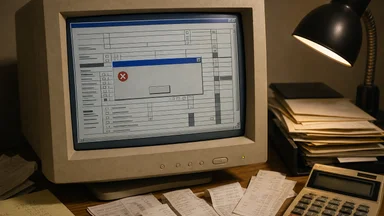
In 1996, the Internal Revenue Service introduced a new computer system intended to modernize tax processing. Instead, it created a nightmare for roughly 14,000 self-employed Americans. The system misclassified their self-employment tax payments as regular employee withholding, effectively erasing credits they had earned for Social Security and Medicare. For many freelancers, the mistake meant unexpected tax bills, liens, and years of bureaucratic battles. This is the story of a technical failure that exposed deep flaws in how tax administration treats the self-employed.
The 1996 IRS System Upgrade That Broke Freelancer Tax Credits
Throughout the early 1990s, the IRS had been working to modernize its aging computer infrastructure. The goal was to improve efficiency and reduce manual processing errors. In 1996, the agency deployed a new system designed to automatically match tax payments to individual accounts. But the software had a critical blind spot: it could not distinguish between self-employment tax payments and the withholding taxes that employers send on behalf of their workers.
Self-employed individuals pay both the employee and employer portions of Social Security and Medicare taxes through Schedule SE. These payments are typically made quarterly or with an annual return. The new system, however, treated any tax payment that arrived without a specific employer identifier as a withholding credit. That meant the system credited the freelancer's account as if they had already paid income tax, but it did not record the self-employment tax liability. The result: the system showed a balance due for the self-employment tax, even though the freelancer had paid it.
According to a 1997 report by the General Accounting Office (GAO/T-GGD-97-3), the error affected an estimated 14,000 taxpayers. The IRS itself acknowledged the problem in internal memos but did not issue a public warning for months. The agency initially blamed the victims, sending automated notices demanding payment. Some freelancers received collection letters for amounts they had already paid. The system had no built-in check to catch the misclassification, and no automated fix existed for over a year.
The scale of the failure was not immediately apparent because self-employment returns are less common than wage-earner returns. But for those affected, the consequences were severe. The average credit loss per freelancer was around $2,500, according to estimates from taxpayer advocacy groups. For a self-employed worker already managing irregular income, that sum could be devastating.
How the Error Slipped Through: A Design Flaw in Tax Administration
The 1996 system upgrade was supposed to reduce manual intervention, but it introduced a new category of error. The software lacked cross-checks between payment types. When a freelancer submitted a payment with a Schedule SE, the system should have matched that payment to the self-employment tax line. Instead, it defaulted to treating the payment as income tax withholding. The design assumed that any payment not explicitly linked to an employer must be a withholding credit—a flawed assumption that ignored the reality of self-employment. This single misclassification mechanism was at the heart of the failure: the system could not distinguish between a self-employment tax payment and an employer's withholding remittance.
Manual review processes were overwhelmed by the volume of returns. IRS staff, many of whom had limited training on self-employment tax rules, were not equipped to spot the pattern. In testimony before Congress in 1997, IRS officials admitted that the new system had been tested primarily on wage-earner scenarios. Self-employment cases were an afterthought. The GAO report later cited "systemic neglect" in the rollout, noting that no independent audit of the software had been conducted before deployment.
The error was compounded by the fact that self-employment tax credits are not visible on the standard tax transcript. Freelancers who called the IRS helpline were often told that their payment had been applied correctly, only to receive a notice months later demanding the same amount. The agency's internal tracking system did not flag the misclassification because it did not generate an error code. The bug was invisible to the people who needed to fix it.
Some critics argued that the IRS had not adequately involved end-users—tax examiners and taxpayer representatives—in the design process. The system was built by contractors with limited understanding of tax law nuances. A similar error had occurred in a smaller pilot program in 1994, but the lessons were not applied to the 1996 rollout. The failure was not just technical; it was organizational.
The Human Toll: Freelancers Facing Unexpected Tax Bills
For freelancers like Maria Gonzalez, a graphic designer in Austin, Texas, the error arrived as a certified letter demanding $3,200 in back taxes. She had paid her self-employment taxes quarterly, keeping meticulous records. But the IRS computer showed her account as delinquent. She spent weeks on the phone, only to be told she needed to submit proof of payment—proof she had already sent. The agency had no record of her Schedule SE filings, even though she had filed them for years.
Stories like Gonzalez's were common. Victims reported receiving notices for amounts ranging from a few hundred dollars to over $10,000. Many had already paid the correct amount, but the system had credited their payments to the wrong category. Some faced liens on their homes or wage garnishments. Unlike employees, who have employers to advocate for them, freelancers had to fight alone. The burden of proof shifted entirely to the taxpayer.
Self-employed workers often operate on thin margins. A $2,500 unexpected tax bill could wipe out a month's savings. Some freelancers took out high-interest loans to pay the disputed amounts, hoping to stop collection actions while they appealed. Others simply gave up and paid twice. The IRS did not automatically refund the overpaid amounts; affected taxpayers had to discover the error and file amended returns.
The emotional toll was significant. Many freelancers reported anxiety, sleepless nights, and distrust of the tax system. Some stopped filing self-employment taxes altogether, fearing further errors. The IRS's failure to communicate the scope of the problem—or to offer a simple fix—eroded confidence in the agency's ability to serve the self-employed. For a population already vulnerable to income instability, the error was a blow.
Paperwork Nightmare: The Burden of Proof Shifted to Victims
Resolving the error required freelancers to submit original payment receipts, bank statements, and copies of Schedule SE forms from prior years. The IRS demanded proof that the payments were actually made and that they were intended for self-employment tax. For freelancers who paid electronically, records were easier to retrieve. But for those who paid by check, the process was a scavenger hunt through old files.
The IRS helpline gave contradictory instructions. Some representatives told callers to file an amended return using Form 1040X. Others said to write a letter explaining the error. Still others insisted the system was correct and the taxpayer owed the money. There was no centralized process for handling the misclassification. Each case was treated as an individual dispute, even though the underlying cause was a system-wide bug.
Some victims spent more than 40 hours gathering documents and making phone calls. A few hired tax professionals, adding hundreds of dollars in fees to their losses. The IRS did not offer compensation for the time or penalties incurred. One freelancer from Chicago reported that it took 14 months and three separate appeals to get the error corrected. During that time, she received a lien notice and had to pay a tax preparer $800 to help.
The burden of proof was particularly unfair because the IRS had the records—they just could not access them correctly. The agency's own database held the payment information, but the system could not link it to the right tax line. Freelancers were forced to do the work that the IRS's software should have done. This asymmetry of information is a recurring theme in tax administration failures.
The Fix That Took 18 Months: What Changed Inside the IRS
By early 1997, the GAO had published a critical report, and Congress held hearings on the IRS's management of technology projects. Under pressure, the agency began reprogramming the system to recognize self-employment tax payments. The fix involved adding a flag to payment records that indicated whether the payment was for self-employment tax. But the reprogramming was not complete until mid-1998—roughly 18 months after the error was first detected.
Manual reprocessing of affected returns began in 1998. The IRS identified approximately 14,000 accounts that had been misclassified and sent letters to those taxpayers, acknowledging the error. However, the letters did not automatically correct the accounts. Taxpayers still had to respond and confirm that they had paid. The agency did not proactively refund any penalties or interest that had accrued, even though the error was its own.
In the aftermath, the IRS implemented new oversight rules for future system rollouts. The GAO recommended that the agency conduct pilot tests with real taxpayer data before full deployment. The IRS also created a dedicated unit for self-employment tax issues, though it was understaffed. The 1996 failure became a case study in the dangers of automating tax administration without considering the diversity of taxpayer circumstances.
But the fix was incomplete. Freelancers who had already paid the disputed amount received no compensation for their time or the interest they had lost. The IRS argued that it had no legal authority to pay damages for administrative errors. A proposed "taxpayer bill of rights" that would have allowed for compensation gained some support but never passed. The incident highlighted a gap in accountability: when a private company makes an error, customers can seek restitution; when the government makes an error, taxpayers are often left to absorb the cost.
Lessons from the 1996 Error: Historical Observations for Self-Employed Taxpayers
The 1996 error is not ancient history. Similar problems have occurred with subsequent IRS system upgrades, including in 2005 and 2012. Freelancers remain disproportionately vulnerable because their income does not fit the standard withholding model. The lesson is that tax software—whether the IRS's or a commercial product—can make mistakes that have serious financial consequences. Historically, those who maintained thorough documentation were better able to resolve disputes, but even then, the process was arduous.
Some tax professionals have noted that the 1996 failure prompted a shift in how self-employed clients prepare their records. For instance, many accountants began advising freelancers to retain bank statements and payment confirmations for at least three years. Others recommended using separate accounts for business and personal finances to simplify tracking. However, these measures were not universally adopted, and the IRS's own processes remained slow to adapt.
It is worth considering why some freelancers might not follow even basic documentation practices. For one, many gig workers operate informally, without separate bank accounts or consistent record-keeping. The time and cost of maintaining detailed records can feel burdensome, especially for those with low or irregular incomes. Additionally, the promise of automated systems can create a false sense of security—if the IRS's software is supposed to handle everything, why keep paper copies? The 1996 error exposed the fragility of that assumption.
The Broader Pattern: When Government Automation Hurts the Self-Employed
The 1996 IRS error is part of a broader pattern of government automation failures that disproportionately affect the self-employed. In 2005, another IRS system update caused delays in processing self-employment tax payments, leading to erroneous penalty notices. In 2012, a new system for matching 1099 forms with tax returns failed to account for multiple income streams, causing freelancers to receive audit notices for income they had correctly reported.
These recurring problems stem from a fundamental mismatch: tax administration systems are designed for the wage-earner model, where one employer withholds and reports income. The self-employed—freelancers, gig workers, independent contractors—do not fit that model. Their income is irregular, their payments are lumpy, and their tax obligations are more complex. Yet the systems treat them as exceptions, and exceptions are where errors breed.
Some experts argue that the IRS should create a separate processing track for self-employment returns, with dedicated software and staff. Others call for a simpler tax code that reduces the need for complex matching algorithms. But change is slow. The IRS's budget has been constrained for years, and technology upgrades are expensive. Meanwhile, the number of self-employed workers has grown, making the problem more pressing.
The 1996 case also illustrates a broader lesson about automation in financial systems. When a bank's software misapplies a payment, the customer can often dispute it and get a quick fix. But when the government's software makes an error, the recourse is limited. The asymmetry of power is stark. Private-sector errors can also be costly, but at least there is a regulator to complain to. For IRS errors, the regulator is the IRS itself.
As automation becomes more pervasive in tax administration, the risk of similar failures grows. The 1996 error was a wake-up call, but it was not a cure. Freelancers today must remain vigilant, because the systems that are supposed to help them can just as easily hurt them. The historical record shows that the best defense against a system error is a well-organized paper trail, but even that is no guarantee of a swift resolution.
Counter-Argument: Why Some Freelancers Might Not Follow Best Practices
While the advice to keep detailed records seems prudent, it is not always practical. Freelancers with low incomes may lack the resources to maintain separate bank accounts or hire accountants. The gig economy has brought millions of workers into self-employment who previously had no need for complex tax planning. For them, the overhead of formal record-keeping can outweigh the perceived risk of an IRS error—especially if they have never experienced one.
Moreover, the IRS's own communication failures compound the problem. Many freelancers are unaware of the 1996 incident or similar subsequent errors. Without that historical context, they may assume the system works correctly. The agency has not made a concerted effort to educate self-employed taxpayers about the risks of automation failures. As a result, the burden of knowledge falls on the individual, which is exactly where it should not be.
There is also a legitimate argument that taxpayers should not have to compensate for government system errors. The onus should be on the IRS to design robust, inclusive systems. Expecting every freelancer to act as their own auditor is an unreasonable standard. Yet, until systemic reforms occur, self-employed individuals must navigate the existing landscape. The 1996 error is a reminder that blind trust in automation is dangerous, but demanding that victims become experts in tax administration is equally unfair.
Conclusion: The Unfinished Legacy of 1996
The 1996 IRS computer error was not a one-off glitch; it was a symptom of a deeper neglect of the self-employed in tax administration. The 14,000 freelancers affected paid a high price for a system that was never designed with them in mind. The 18-month fix was too slow, and the compensation was nonexistent. Subsequent failures show that the lessons of 1996 have not been fully absorbed.
For freelancers today, the best course of action is to be proactive: keep records, check transcripts, and question any unexpected notices. But this advice should not let the IRS off the hook. The agency must do better—by testing systems with real self-employment data, by providing clear communication when errors occur, and by compensating victims when its mistakes cause harm. Until then, the 1996 error stands as a cautionary tale of what happens when technology outruns empathy.
This article is for informational purposes only and does not constitute professional tax advice. Consult a qualified tax professional for guidance on your specific situation.