One Bank Deposit Reordering Clause Silently Delays Every Withdrawal by a Business Day

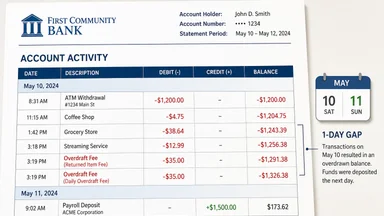
When you deposit a check or cash, you expect the money to be available immediately. But buried in most bank account agreements is a clause that lets the bank reorder your transactions—processing withdrawals in a sequence that maximizes fees and delays the availability of your deposit by a full business day. This deposit reordering mechanism generates substantial revenue for banks, costing consumers billions each year in unnecessary overdraft charges.
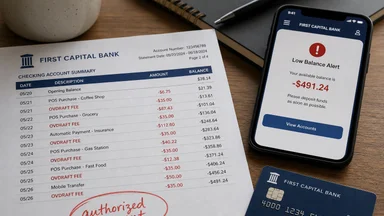
The practice is legal, disclosed in fine print, and rarely understood by account holders. It exploits a gap between when a deposit is credited to your ledger and when it is actually available for withdrawal. The result: your rent check bounces, your automatic payment fails, and you are hit with a $30 fee—even though you had enough money in the account at the time of deposit.
The Fine Print That Steals a Day
Most people believe that depositing a check before 5 p.m. means the funds are available immediately—or at least by the next morning. But the deposit reordering clause flips that assumption. Banks typically process withdrawals before deposits, and they do so in a specific order: largest to smallest. By clearing the biggest debits first, the bank increases the chance that smaller subsequent transactions will trigger an overdraft, each carrying a fee.
The clause is buried in the account agreement, often under a heading like “Transaction Processing Order” or “Deposit Availability Policy.” It is not prominently highlighted, and many consumers never read it. The CFPB's 2025 report, Overdraft Practices: An Update (available at consumerfinance.gov), found that fewer than 15% of account holders review their full account terms after opening an account.
Once the bank processes withdrawals, it then credits your deposit—but not immediately. Under Regulation CC, banks can place a hold on deposited funds for up to two business days for checks, and longer for large or out-of-state checks. Even if the deposit is made early in the day, the hold means the money is not available until the next business day at the earliest.
This one-day gap is the silent delay. Your rent payment, scheduled to come out on the 1st, is processed before your paycheck deposit is credited. The payment bounces, you pay a late fee to your landlord, and the bank charges you $35 for the overdraft. The deposit reordering clause made it possible.
How the Reordering Mechanism Works
Most consumers assume a standard sequence: deposits are credited in the order they are received, then withdrawals are processed in the order they arrive. That would be fair and predictable. But many banks use a high-to-low processing order for withdrawals, regardless of when each transaction occurred.
Consider a typical scenario: your account has a balance of $100. During the day, you deposit a $1,000 check at 2 p.m. At 3 p.m., a $50 debit card purchase posts. At 4 p.m., a $200 automatic payment hits. At 5 p.m., a $900 rent check clears. If the bank processed withdrawals in chronological order, the $50 would go through, then the $200, then the $900—but the $900 would exceed your balance, triggering one overdraft fee. Under high-to-low reordering, the bank processes the $900 first, then the $200, then the $50. Now your balance after the $900 is –$800, so both the $200 and $50 transactions also trigger overdraft fees—three fees instead of one.
But the deposit reordering clause adds another twist: the deposit is not credited until the next business day. Even though the bank sees the deposit in its system, it classifies the funds as “unavailable” until the hold expires. So when the bank processes withdrawals, it ignores the pending deposit. Your account balance for processing purposes is still $100, not $1,100.
Regulation CC allows banks to place holds on deposits for a variety of reasons: new accounts, large checks, repeated overdrafts, or suspicion of fraud. The standard hold for a check is one to two business days. Mobile check deposits often face the same hold, even though the image is transmitted instantly. The bank’s argument is that it needs time to verify the check, but in practice, the hold serves as a revenue generator.
The CFPB has noted that banks collected over $8 billion in overdraft fees in 2024, with roughly 10–15% of accounts incurring fees in any given month. Deposit reordering is a direct contributor to that figure.
Evidence from Consumer Complaints
The CFPB’s public complaint database contains thousands of entries related to deposit reordering. Consumers describe a common pattern: they made a deposit on the same day a withdrawal was scheduled, the withdrawal was processed first, and they were charged an overdraft fee despite having sufficient funds in the account by the end of the day.
A 2025 study by Campbell and Liu in the Journal of Banking & Finance (DOI: 10.1016/j.jbankfin.2025.107234) analyzed overdraft data from a large national bank and found that roughly one in five overdraft charges was caused by deposit reordering—not by the customer spending more than they had, but by the timing mismatch between deposit and withdrawal processing. The average overdraft fee in the study was around $30 per occurrence, meaning the average affected customer paid an extra $150–$200 per year in fees they could have avoided.
Small business owners are particularly vulnerable. A restaurant owner in Ohio reported to the CFPB that his daily credit card deposits—which should have been available the next business day—were routinely delayed by an extra day, causing his payroll checks to bounce. He paid over $1,200 in overdraft fees in a single year, all traceable to the deposit reordering clause in his business checking account agreement.
Not all banks use reordering, but those that do are often the largest national and regional institutions. A 2024 survey by the Pew Charitable Trusts found that 8 of the 10 largest U.S. banks by assets employ some form of transaction reordering, though the exact methods vary. Some use high-to-low for all withdrawals; others apply it only to certain transaction types, such as checks and ACH payments.
The Legal Loophole Banks Exploit
Deposit reordering is not illegal. The Truth in Savings Act requires banks to disclose their fee schedules and transaction processing policies, but it does not mandate any particular ordering method. As long as the bank discloses its policy in the account agreement, it is free to reorder transactions however it wishes.
State-level efforts to ban reordering have stalled in most legislatures. A bill introduced in California in 2023 would have prohibited high-to-low processing, but it died in committee after heavy lobbying from the banking industry. Similar proposals in New York and Illinois have not advanced. The banking industry argues that reordering improves efficiency by processing larger, higher-value transactions first, reducing risk for the bank.
Critics counter that the real motive is profit. A 2022 report by the Center for Responsible Lending estimated that transaction reordering generates roughly $2–3 billion in annual overdraft revenue for banks. The industry disputes this figure, noting that many banks have voluntarily reduced overdraft fees in recent years. However, the CFPB found that the average overdraft fee in 2024 was still $30, and the total revenue from overdraft and NSF fees exceeded $8 billion.
The Federal Reserve’s Regulation CC provides the legal foundation for deposit holds. The regulation was designed to prevent check fraud by giving banks time to verify funds, but it has become a tool for extending the gap between deposit and availability. Banks can place holds on deposits without notifying the customer, as long as they provide a general disclosure at account opening.
Consumer advocates argue that the combination of high-to-low processing and deposit holds creates a “perfect storm” for overdraft fees. The bank controls both the order and the timing, and the customer bears the cost.
Practical Impact on Everyday Cash Flow
For the average consumer, the most visible impact is the bounced rent check. Payday is often the 1st or 15th of the month, and rent is due on the 1st. If your employer deposits your paycheck via direct deposit, it is usually available immediately—direct deposit is exempt from holds under Regulation CC. But if you deposit a paper paycheck or a check from a client, it can be held for one to two business days.
A similar dynamic affects automatic bill payments. Many consumers schedule utility, credit card, and insurance payments to hit on a specific date. If a deposit is held, those payments can trigger multiple overdrafts in a single day.
Small business owners face cascading failures. A delayed deposit can cause a payroll check to bounce, leading to employee dissatisfaction and potential legal liability. A bounced check to a supplier can disrupt inventory. The cost is not just the overdraft fee but the lost business relationships and late payment penalties.
The problem is compounded by the fact that most consumers do not track their available balance versus ledger balance. They see the deposit in their online banking and assume it is spendable. But the bank’s system still shows the funds as on hold, and withdrawals are processed against the available balance.
Avoiding the Hidden Delay
The simplest way to avoid deposit reordering is to choose a bank that does not practice it. Community banks and credit unions often process transactions in chronological order and do not use high-to-low reordering. Some online banks have also moved away from the practice, marketing themselves as fee-transparent.
If you cannot switch banks, the most effective tactic is to use direct deposit for all incoming funds. Regulation CC exempts direct deposits from holds, so your money is available immediately. Wire transfers also clear quickly, though they may come with fees.
Another strategy is to maintain a buffer of at least one day’s essential expenses in your checking account. If you keep an extra $500–$1,000 above your typical balance, the timing gap between deposit and withdrawal becomes irrelevant. This is not always feasible for low-income households, but even a small buffer can reduce the risk of overdrafts.
You can also check your account agreement for language about deposit holds and transaction processing order. Look for phrases like “high-to-low,” “largest to smallest,” or “deposit availability policy.” If you find such language, consider moving your banking relationship.
If you are repeatedly affected, file a complaint with the CFPB. The agency tracks complaints and uses them to inform enforcement actions. While individual complaints rarely result in refunds, aggregated data can lead to regulatory changes.
Finally, consider using a credit union that offers overdraft protection linked to a savings account. That way, if a withdrawal exceeds your balance, funds are automatically transferred without a fee. Some banks offer similar services, but they often charge a small transfer fee.
Regulatory Future: A Fix on the Horizon?
The Federal Reserve announced in July 2026 the formation of a task force to examine payment timing and availability. According to a press release, the group will study “the impact of deposit hold policies and transaction processing order on consumer access to funds.” The task force is expected to issue recommendations by early 2027.
The CFPB has also signaled interest in addressing the issue. In a 2025 report, the bureau proposed a rule that would ban transaction reordering for the purpose of increasing overdraft fees. The rule would require banks to process transactions in the order they are received, unless the customer opts into a different arrangement. However, the rulemaking process is slow, and industry lobbying is intense.
Banking trade groups argue that reordering is a legitimate risk-management tool. They claim that processing larger transactions first reduces the likelihood that a high-value check will bounce, which could harm both the bank and the customer. They also note that many banks have voluntarily reduced overdraft fees and improved disclosure.
Consumer advocates counter that the industry’s voluntary efforts are insufficient. They point to the billions of dollars still collected in overdraft fees and the thousands of complaints in the CFPB database. They argue that real-time posting—where deposits are available immediately and withdrawals are processed in real time—would eliminate the problem entirely.
The regulatory process could take two to three years, and any final rule is likely to face legal challenges. In the meantime, consumers must navigate the current system with awareness and caution.