Two Liability Policies on a Single Scaffolding Collapse Paid Under Different Jurisdiction Rules

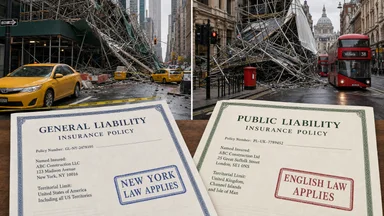
A scaffolding collapse is a general liability adjuster’s textbook event. A pedestrian is injured, a contractor is sued, and a policy is triggered. But which policy, and how much it pays, depends less on the accident itself than on where it happened. A New York contractor and a London contractor can buy what appears to be the same product—commercial general liability insurance—yet face radically different coverage outcomes when a scaffold gives way. The mechanical reasons lie in policy form, pricing regulation, and the treatment of legal costs. This article walks through a paired claim scenario to show how jurisdiction rewrites the same risk.
One Collapse, Two Bills: How Jurisdiction Rewrites the Same Risk
Consider two nearly identical incidents. In New York City, a scaffolding tube slips during a building renovation, striking a pedestrian on the sidewalk. The pedestrian suffers a broken arm and files a lawsuit against the general contractor. In London, a similar scaffold failure occurs on a high-street shopfront, injuring a passerby who also brings a claim. Both contractors carry general liability insurance. Both policies were purchased in the same year, for the same class of work: building construction. Yet the insurance outcomes diverge sharply.
The divergence begins with the policy trigger. In the United States, the standard commercial general liability policy is an occurrence form. It covers bodily injury or property damage that happens during the policy period, regardless of when the claim is made. The New York contractor’s policy covers the collapse because the injury occurred within the policy term. The insurer is on the hook even if the lawsuit arrives a year later.
In the United Kingdom, the standard public liability policy is a claims-made form. It covers only claims first made against the insured during the policy period. If the London contractor’s policy expires before the collapse, the claim falls outside the policy period. The insurer may deny coverage unless the contractor bought an extension or a later policy that picks up the claim. The same accident type, two different coverage triggers, and two entirely different outcomes.
The pedestrian in New York receives compensation from the policy. The pedestrian in London may face a coverage dispute hinging on when the claim was notified. The contractor in London might have to rely on a later policy, or worse, discover a gap. This is not a defect in one market or the other; it is a structural difference in how liability insurance is sold and regulated in each jurisdiction.
Occurrence vs Claims-Made: The Mechanical Divide
The occurrence form is the default in the United States for general liability. It defines coverage by the timing of the injury or damage. As long as the harmful event happens while the policy is in force, the insurer must respond, even if the claim is reported years later. This gives the insured long-tail protection, which suits construction work where injuries may surface slowly, like repetitive stress or latent defects.
The claims-made form, dominant in the United Kingdom for public liability, defines coverage by the timing of the claim. The policy covers only claims first made and reported during the policy period. If the claim is reported after the policy expires, there is no coverage unless a “run-off” or “extended reporting period” endorsement was purchased. This shifts the timing risk to the insured: they must ensure timely notification or buy tail coverage.
In our scaffold scenario, the New York contractor’s occurrence policy covers the collapse. The insurer pays defense costs and any settlement or judgment. The London contractor’s claims-made policy, however, does not cover the claim unless the contractor can show that the claim was first made before the policy expired—which it was not. The London insurer denies coverage, citing late notice. The contractor must then look to their next policy, if they renewed with the same carrier, or face a coverage gap.
This mechanical difference is not trivial. Industry data from a 2023 report by the International Insurance Society suggests that a notable portion of claims-made policies in the UK result in coverage disputes related to notice timing. In the US, occurrence forms produce fewer such disputes, but they generate more litigation over whether the injury actually occurred during the policy period, especially in latent-damage cases. Each form has its own friction points.
Pricing Signals: Why Premiums Diverge by a Factor of Two
Premiums for general liability in the US and UK differ by a factor of roughly two for similar construction risks. For a contractor with a given payroll, a US commercial general liability policy might cost between $20,000 and $40,000 annually (at a rate per $100 payroll). A comparable UK public liability policy might cost between £10,000 and £20,000 (at a similar rate per £100 payroll). The US rate is higher because it includes a built-in litigation cost load.
Defense costs in the US are typically “inside the limits,” meaning they erode the policy’s indemnity limit. If the policy has a $1 million aggregate limit and defense costs consume $300,000, only $700,000 remains for settlements or judgments. Insurers thus price for the expectation that a significant portion of the limit will go to lawyers. In the UK, defense costs are typically “outside the limits,” paid in addition to the indemnity limit. A $1 million policy in the UK can pay the full $1 million to settle a claim, with defense costs on top.
This pricing gap also reflects litigation frequency. The US has a higher rate of lawsuits per capita than the UK. According to data from the Organisation for Economic Co-operation and Development, the US has roughly 44 lawyers per 10,000 people, compared to about 22 in the UK. More lawyers correlate with more claims, and insurers price for that. The UK market, with lower litigation frequency, can offer lower premiums for the same nominal coverage.
But the lower UK premium comes with a trade-off: the insured bears more risk of a coverage gap if they fail to notify a claim promptly. The US premium, while higher, buys more certainty of coverage for events that happen during the policy period. A risk manager comparing the two must weigh the upfront cost against the potential for uninsured loss.
Regulatory Handcuffs: New York's Prior Approval vs London's Market Freedom
Insurance pricing in New York is tightly regulated. The state’s Department of Financial Services requires insurers to file rates and forms for prior approval before they can be used. A carrier that wants to raise rates for general liability must submit actuarial justification and wait for approval, a process that can take months. This dampens market volatility but also slows the market’s ability to react to emerging loss trends.
In London, the market operates on a “freedom with publicity” model. Insurers set their own rates without prior regulatory approval, subject to post-hoc oversight by the Prudential Regulation Authority and the Financial Conduct Authority. If a big claim hits a particular class—say, scaffolding contractors—underwriters can reprice the next renewal immediately. This makes the UK market more reactive, but also more prone to sharp swings.
After a series of large scaffold claims in New York in a recent year, for example, rates for construction general liability rose gradually over two years because of the prior-approval process. In London, after a similar loss cluster, some underwriters raised rates by a larger percentage in a single renewal cycle. Contractors in New York complain about slow regulatory response; contractors in London complain about whiplash pricing.
The regulatory environment also affects product innovation. In New York, any change to policy language—such as adding a new exclusion—must be filed and approved. In London, underwriters can amend wording on a case-by-case basis, subject only to market practice and broker negotiation. This flexibility allows UK insurers to tailor coverage more precisely, but it also creates inconsistency. Two contractors in the same trade might have materially different policy terms from two different carriers.
Loss Adjustment: How Defense Costs Eat Coverage Differently
The treatment of defense costs is perhaps the most consequential difference for the insured. In the US, the standard commercial general liability policy includes defense costs within the limit of insurance. A policy with a $500,000 per-occurrence limit and $200,000 in defense costs leaves only $300,000 to pay a settlement or judgment. The insured’s indemnity is effectively reduced by the cost of fighting the claim.
In the UK, the standard public liability policy pays defense costs in addition to the limit. The same $500,000 limit covers the full settlement amount, and defense costs are paid on top. This means that for a claim of equal severity, the UK insured retains more of the policy’s indemnity capacity. The New York contractor in our scaffold scenario with a $500,000 limit and $200,000 in defense costs has only $300,000 left to pay the pedestrian’s claim. The London contractor with the same limit and similar defense costs has the full $500,000 for the settlement.
This difference has a direct impact on the insured’s net exposure. In the US, if the pedestrian’s claim settles for $400,000, the policy pays only $300,000, and the contractor must fund the remaining $100,000 out of pocket. In the UK, the policy pays the full $400,000, plus the $200,000 in defense costs, for a total of $600,000—all covered. The US contractor faces a $100,000 gap; the UK contractor does not.
Insurers in both markets argue their approach is rational. US carriers say defense-within-limits aligns incentives: the insured has a stake in controlling legal costs. UK carriers say defense-outside-limits provides full indemnity. A survey by the Risk and Insurance Management Society found that a majority of US risk managers would prefer defense-outside-limits, but only a small fraction have it. The market structure, not buyer preference, dictates the term.
Broker's Choice: How a Buyer Navigates the Split
A multinational contractor operating in both New York and London cannot simply buy one global policy. Insurance regulation and policy forms are jurisdiction-specific. The typical solution is to purchase a local admitted policy in each country, then wrap them with a global excess layer that fills gaps. The New York policy will be an occurrence form with defense-within-limits; the London policy will be a claims-made form with defense-outside-limits.
The broker’s job is to identify the gaps. For example, if the contractor’s employee works temporarily in another jurisdiction, which policy applies? The US policy may cover work anywhere in the world if the suit is brought in the US, but the UK policy may exclude US exposures. The broker must structure a “difference in conditions” or “difference in limits” policy to cover cross-border risks.
Another gap arises from the trigger difference. If the contractor has a project that spans policy years, the occurrence form covers injuries during construction, while the claims-made form requires a claim during the policy period. The broker may recommend a “project policy” that blends both forms, or a “manuscript” wording that overrides the standard trigger. Such bespoke solutions are common in large construction programs but expensive for smaller contractors.
The complexity also affects claims handling. When a claim arises, the adjuster must determine which jurisdiction’s rules apply. A New York adjuster might assume defense-within-limits; a London adjuster assumes defense-outside-limits. If the contractor has a global program, the lead carrier may need to coordinate across both approaches, which can delay payment and create friction. A broker experienced in multi-jurisdiction placements is essential.
Takeaway for the Risk Manager: One Standard Does Not Fit
The scaffolding collapse story is a reminder that liability insurance is not a commodity. The same risk—a falling scaffold—produces different coverage outcomes depending on where the accident happens. The trigger form, the treatment of defense costs, the regulatory environment, and the pricing structure all vary by jurisdiction. A risk manager who assumes their US policy will respond the same way in the UK, or vice versa, is setting up for a surprise.
When buying coverage for operations in multiple jurisdictions, the first step is to understand the local standard form. Is it occurrence or claims-made? Are defense costs inside or outside the limit? Is rate regulation strict or flexible? These questions should be answered before a claim arises. A broker who specializes in cross-border placements can help map the differences and fill the gaps with excess layers or manuscript endorsements.
There is no single “best” system. The US occurrence form offers long-tail security but at a higher premium and with defense costs that erode limits. The UK claims-made form offers lower premiums and full defense-cost indemnity but shifts the timing risk to the insured. Each has trade-offs, and the right choice depends on the contractor’s risk appetite, project duration, and geographic footprint.
Ultimately, insurance is a contract of adhesion—the insurer writes the terms, and the buyer accepts them. But the buyer can choose which jurisdiction’s terms to accept, or can negotiate modifications. The scaffold collapse is a teachable moment: the fine print matters, and jurisdiction can rewrite coverage. Working with a broker who understands the jurisdiction split and can structure coverage that matches the real-world risk is a prudent step, but each buyer must evaluate their own circumstances.
This article is for informational purposes only and does not constitute professional insurance advice. Coverage terms vary by policy and jurisdiction. Consult a licensed broker or legal professional for guidance on your specific situation.