One Small Town’s Zoning Map Blocks All New Mortgages Within Its Boundary

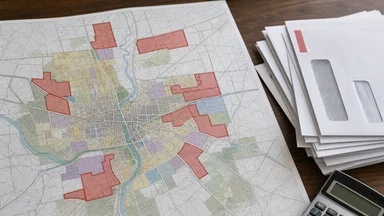
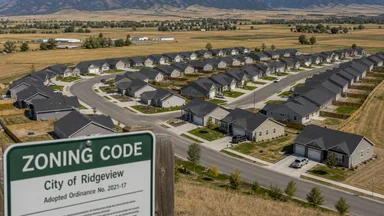
In a small Midwestern town of roughly 4,200 residents, a zoning map adopted in 2022 has quietly frozen the mortgage market. The ordinance, intended to limit residential expansion and preserve the town's rural character, restricts new housing units so severely that lenders have effectively stopped originating purchase mortgages. Existing homeowners find themselves trapped with old loans, unable to refinance or sell at a price that reflects their equity. This is not a story about a housing crash—it is about a regulatory choke point that standard mortgage rules cannot handle.
The Zoning Law That Quietly Killed Mortgage Lending
The town council enacted a zero-lot-expansion rule in early 2022, capping the floor-area ratio at 0.4 for any residential property. In practice, this meant no new housing units could be built on existing lots, and even additions that increased square footage beyond the limit were prohibited. The stated goal was to prevent overdevelopment and maintain the town's aesthetic. But the unintended consequence was immediate: no new housing units have been permitted since the ordinance took effect.
Local real estate agents noticed the shift within months. Listings dried up because sellers who wanted to downsize or relocate could not find buyers with financing. Banks, following standard underwriting guidelines, refused to issue purchase mortgages without recent comparable sales—comps—to appraise the collateral. The town's only credit union, which had been a portfolio lender for decades, also stopped originating mortgages after its secondary-market investor pulled out.
The local Realtors association sued the town in early 2023, arguing that the zoning ordinance effectively deprived property owners of the economic value of their homes. The court upheld the ordinance in late 2024, ruling that the town had acted within its police powers. The decision was not appealed. By early 2025, only three cash sales had closed in the town, all at prices well below what financed buyers would have paid.
How a Single Map Clause Blocks Every Loan Application
The key provision is the floor-area ratio (FAR) cap of 0.4. For a typical lot of 10,000 square feet, that limits the total floor area to 4,000 square feet—but because most homes in the town were built before the ordinance, they already exceed that ratio. Any expansion or new construction is prohibited unless the homeowner tears down existing square footage first, which is economically impractical. The result is a complete halt to new housing supply.
Appraisers cannot find comparable sales because there are none. The Uniform Standards of Professional Appraisal Practice require at least three recent sales of similar properties in the same market area. With zero sales in the tract since 2022, appraisers must either expand the search area (which yields properties in different zoning regimes) or use older sales (which are stale and not reflective of current conditions). Both approaches produce valuations that lenders deem unreliable.
Lenders rely on those appraisals to satisfy federal and secondary-market requirements. The Federal Housing Administration (FHA) pulled its approval for the town's entire census tract in mid-2023, citing insufficient market activity. The U.S. Department of Agriculture (USDA), which guarantees rural mortgages, followed suit. Without these federal backstops, even conventional lenders backed away.
Refinance applications are also rejected. Homeowners hoping to lower their interest rate or tap equity for renovations find that lenders require the same appraisal process. Without comps, the loan-to-value ratio cannot be determined, and the application is denied. The only refinancing option would be a portfolio loan held on a local bank's balance sheet, but no local bank has the appetite for such risk.
The Equity Trap: Homeowners Who Cannot Sell or Borrow
On paper, homeowners in the town have seen their equity rise. Median home values, estimated by automated valuation models, increased roughly 18% from 2022 to early 2025, reflecting national trends. But that equity is theoretical. No buyer can obtain financing, so no one can pay that estimated value. Cash sales are rare—only three closed in all of 2025, according to county records—and those were at prices roughly 20% below the automated estimates.
Owners who want to sell are stuck. They cannot move for a job, downsize for retirement, or relocate for family reasons unless they find an all-cash buyer. The pool of such buyers is tiny, and those who do appear often demand steep discounts. One homeowner, a retired teacher who listed her house in 2024, received no offers after 18 months on the market. She eventually withdrew the listing.
Homeowners also cannot tap their equity for home improvements or emergencies. A couple needing a new roof could not get a home equity loan or line of credit. The bank cited the same lack of comps, making it impossible to underwrite the loan. The couple paid for the roof out of savings, depleting their emergency fund.
Property values in the town are realizable only in theory. The county assessor continues to raise assessed values based on market trends, which increases property taxes. But owners cannot convert that paper gain into cash. The equity trap is real: wealth that exists on a spreadsheet but cannot be accessed.
The human toll extends beyond financial frustration. A local real estate agent described a client who had accepted a job offer in another state but could not sell her home. She eventually had to rent it out at a loss, covering the mortgage from her new salary. Another family wanted to downsize after their children left for college, but they could not find a buyer for their four-bedroom house. They remain in a home that is now too large, paying higher utility bills and property taxes on a property they cannot monetize.
The emotional impact is significant. Several homeowners reported feeling trapped and anxious, unable to make long-term plans. The inability to access equity meant they could not fund children's education, start a business, or make necessary home repairs. The town's mental health counselor noted an uptick in stress-related visits among homeowners, directly attributable to the housing situation.
Why Standard Mortgage Rules Fail in Zero-Supply Markets
The mortgage system is built on the assumption of an active market. The Federal Housing Administration, Fannie Mae, and Freddie Mac all require appraisals based on comparable sales. The Government-Sponsored Enterprises (GSEs) have guidelines that explicitly require the appraiser to identify at least three closed sales within the past 12 months. When no such sales exist, the loan cannot be securitized, and most lenders will not originate it.
Small-town banks and credit unions that once held mortgages in portfolio have largely retreated from that business. The 2008 financial crisis and subsequent regulations made portfolio lending less attractive. Most community banks now sell their loans to larger aggregators or the GSEs. If a loan cannot be sold, they will not make it. One regional lender's escrow surplus clause shows how even routine servicing provisions can affect cash flow, but the core problem here is more fundamental: no market means no loans.
USDA and FHA have no exception clause for zoning-induced illiquidity. Their handbooks mention that appraisers may use older sales or sales from competing areas, but only if they can be adjusted. In this town, the adjustments are so large—reflecting a completely different regulatory environment—that the appraised value becomes speculative. The agencies have not issued guidance for such situations, leaving lenders to default to rejection.
Some observers argue that the mortgage system is too rigid. A 2024 paper from the Mercatus Center suggested that regulators could allow alternative valuation methods, such as automated valuations or tax-assessed values, for markets with fewer than five sales per year. But no such rule change has been adopted. The town's situation remains a gap in the regulatory framework.
Critics of this view counter that flexibility could introduce new risks. Allowing tax-assessed values, which are often based on mass appraisal models, might overstate collateral value in declining markets. Automated valuations depend on data from active markets and may not capture local nuances. The tension between liquidity and accuracy is inherent in any appraisal system, and regulators have historically erred on the side of requiring actual sales data. This caution, while prudent in normal times, exacerbates the problem in a market like this one.
One Family's Experience: Stuck With a 2019 Rate
The Martinez family bought their three-bedroom home in 2019, locking in a 30-year mortgage at 3.8%. By 2024, they wanted to refinance to fund a kitchen remodel. They had built roughly $60,000 in equity, based on the rise in local tax assessments. Their bank, a regional lender with a branch in the town, initially seemed open to the idea.
But the appraisal came back with a caveat: no comparable sales in the previous 12 months. The appraiser used sales from a neighboring county, which had different zoning and higher prices. The adjusted value was too uncertain, and the bank denied the refinance. The Martinez family was offered a rate of 6.5% on a new purchase elsewhere, but they could not sell their current home to take advantage of it.
They remain in the home, unable to remodel or move. The kitchen has outdated cabinets and a leaky faucet. They considered a home equity line of credit but were told the same problem applied. Their only option is to save cash for improvements, which will take years. The frustration is palpable: they are not underwater, but they are stuck.
The Martinez family's story is not unique. A survey by the local Chamber of Commerce found that 40% of homeowners in the town had considered selling or refinancing in the past two years, but fewer than 5% had succeeded. Most gave up after the first bank rejection.
Another example is the Chen family, who purchased their home in 2020 with a 30-year mortgage at 2.9%. When interest rates dropped further in 2021, they wanted to refinance but were told they needed equity. By 2023, they had paid down enough principal to have roughly $50,000 in equity, but the zoning freeze had already taken effect. Their refinance application was denied due to lack of comps. They are now paying a rate that is roughly 2 percentage points higher than current market rates for comparable borrowers, costing them an estimated $150–200 per month in extra interest, which they cannot recoup.
Workarounds That Exist—and Why They Rarely Work
A few mechanisms might bypass the appraisal bottleneck, but each has significant drawbacks. Seller financing, where the seller holds the mortgage, does not require a bank appraisal. The buyer and seller agree on a price and terms, and the seller collects payments. But the seller must be willing to act as a bank for decades, tying up capital that could be invested elsewhere. Few sellers have the financial flexibility or risk tolerance to do this.
Land contracts, also known as contracts for deed, avoid mortgage recording altogether. The buyer takes possession but does not receive the deed until the contract is paid off. This structure has a long history in rural areas, but it carries title risk for the buyer. If the seller has a lien or dies, the buyer's interest may be compromised. Most real estate attorneys advise against land contracts unless both parties have legal representation.
A small local credit union attempted to create a portfolio loan product specifically for the town. It would hold the loan on its books, bypassing secondary-market requirements. But after a preliminary analysis, the credit union's board pulled back, citing the difficulty of pricing loans without market data and the concentration risk of having too many loans in a single, illiquid market.
Another theoretical workaround is a shared-equity arrangement, where an investor provides financing in exchange for a share of future appreciation. But such arrangements are rare in small towns and require legal structures that most residents are unfamiliar with. The bottom line: no scalable, low-cost workaround exists for a market with zero supply.
Trade-offs are evident in each option. Seller financing, for example, might work for a motivated seller who has no heirs and is willing to accept a stream of payments. But the seller must also consider inflation risk, default risk, and the opportunity cost of not having a lump sum. A land contract can be structured with a balloon payment after a few years, but that assumes the buyer can then obtain conventional financing—which may not be available if the zoning freeze persists. The credit union's portfolio loan idea failed because of regulatory capital requirements; holding a loan with no market price requires higher capital reserves, which small institutions cannot easily meet.
Some have suggested that the town itself could create a municipal lending program, using property tax revenue as a backstop. However, towns rarely have the legal authority or financial expertise to act as lenders. A 2023 report from the Lincoln Institute of Land Policy examined similar cases and found that municipal lending programs had been attempted in only a handful of jurisdictions, and none had succeeded in a market with zero transaction volume.
What Other Towns Can Learn From This Cautionary Tale
A zoning freeze is, in effect, a de facto mortgage ban. Municipalities considering similar restrictions should model the liquidity impact before enacting them. The town's experience shows that even well-intentioned land-use regulations can inadvertently destroy the ability to finance homes. One tax deduction form section that treats software as inventory shows how small regulatory details can have outsized effects, and zoning is no different.
State legislatures could step in. A few states have considered bills requiring that appraisal guidelines accommodate markets with low transaction volumes. For example, a 2025 bill in Minnesota would have allowed the use of tax-assessed values as a floor for appraisals in census tracts with fewer than 10 sales per year. It did not pass, but the idea has bipartisan support. Other states could follow.
Fannie Mae has a pilot program that uses automated valuation models for refinances in disaster areas, where comparable sales may be disrupted. That program could be expanded to cover zoning-induced illiquidity. But so far, the GSEs have not acted, and the town remains an outlier.
Homeowners considering a purchase in a small town should check the zoning code before buying. A map that prevents new construction may also prevent them from ever selling or refinancing. The town's story is a cautionary tale for anyone who assumes that real estate is always liquid. It is not—and a single map clause can prove it.
For policymakers, the lesson is clear: zoning decisions have downstream effects on credit markets that are often overlooked. A comprehensive impact analysis should include a liquidity assessment, estimating how many sales are likely to occur under the new rules. If the projected number falls below a threshold—say, 10 sales per year—the municipality should consider alternative approaches, such as allowing limited infill development or creating a variance process for hardship cases. The town's current predicament could have been avoided with a simple exception: a provision allowing new construction on lots that were already subdivided before the ordinance, or a density bonus for affordable units. But no such exception was included, and the result is a frozen market.
The broader implication for real estate markets is that liquidity is not guaranteed. Homeowners in any jurisdiction with restrictive zoning should be aware that their ability to sell or borrow depends on a continuous stream of transactions. When that stream stops, the value of their property becomes largely theoretical. This case study serves as a reminder that the health of a housing market depends not only on prices but also on the volume of transactions that make those prices meaningful.
Disclaimer: This article is for informational purposes only and does not constitute legal, financial, or real estate advice. Readers should consult qualified professionals for advice specific to their situation.