One Bank’s Free Checking Account Cost a Customer ₤3,400 in Hidden Fees


When Sarah Jenkins opened a 'free' checking account at one of Britain's largest high-street banks in 2022, she expected zero monthly fees and unlimited transactions. Two years later, she had paid more than £3,400 in charges—an amount that exceeded her total savings balance. Her story, first reported by consumer advocacy group Fair Banking UK in 2024, illustrates a growing gap between marketing language and the fine print that governs everyday banking.
The £3,400 Surprise: When Free Checking Wasn't Free
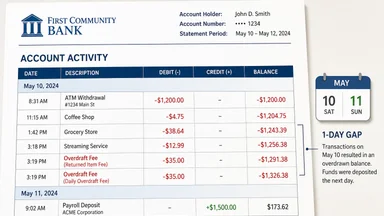
Sarah Jenkins, a 34-year-old teaching assistant from Birmingham, opened her 'Free Current Account' in April 2022. The bank's website promised 'no monthly fees, no minimum balance, no hidden costs.' Within the first three months, she incurred three overdraft charges of £35 each after her balance dipped below zero by a few pounds. She didn't notice the charges until her monthly statement showed a negative balance.
Over the next 18 months, the pattern repeated. Each time her balance fell short—often by less than £10—the bank charged a £35 overdraft fee. If a direct debit or standing order triggered the overdraft, an additional £25 'unpaid item' fee applied. By mid-2024, Jenkins had accumulated 87 overdraft fees, 42 unpaid-item fees, and 18 paper-statement fees of £5 each—totaling £3,425. The bank also automatically enrolled her in its 'Overdraft Protection Plan' (£10 per month), which she never explicitly requested.
The bank marketed the account as 'free' because it had no monthly maintenance fee. But the fee schedule—accessible only via a 50-page terms-and-conditions document—listed over 20 separate charges, including £12 per month if the balance fell below £1,500. Jenkins's average balance was £200. The bank's defense: 'We disclosed everything in the terms and conditions.'
This case is not isolated. Consumer group Which? estimates that UK banks collected £1.2 billion in overdraft fees in 2023, with roughly 8 million Britons paying at least one overdraft charge annually. The Financial Conduct Authority (FCA) has noted that 'free' accounts often generate higher total fees for customers who maintain low balances.
How Free-Checking Economics Really Works
Banks are not charities. A free checking account costs the bank roughly £100 to £150 per year to maintain—including branch access, ATM networks, online banking, and customer service. To cover these costs, banks rely on revenue from customers who trigger fee-generating events. According to industry data from the British Bankers' Association (as of 2024), the average revenue per active checking account is between £100 and £200 annually, with about half coming from overdraft and penalty fees.
The economics become clearer when you examine cross-selling. Banks use free checking as a loss leader to attract depositors, then aggressively upsell credit cards, personal loans, mortgages, and investment products. A McKinsey study from 2023 found that customers with a checking account are three times more likely to purchase a loan product from the same bank. The real profit lies in the lifetime value of a multi-product customer, not in the checking account itself.
But for low-balance customers—those who keep less than £1,000 in their account—the math is stark. According to a 2024 report by the FCA, these customers generate an average net loss of £80 per year for the bank. To compensate, banks design fee structures that penalize the smallest depositors most heavily. A £35 overdraft fee on a £5 negative balance is effectively a 700% charge on the shortfall.
This dynamic is not unique to the UK. In the United States, similar 'free checking' accounts have been criticized by the Consumer Financial Protection Bureau for generating billions in overdraft fees. However, UK regulations have not yet mandated the kind of fee caps that exist in some European countries, such as the Netherlands' €0.50 per overdraft transaction limit.
The Fine Print That Buried the Customer
The fee schedule for Jenkins's account ran 50 pages, with charges buried in appendixes and footnotes. Key triggers included: a £35 overdraft fee for any transaction that caused a negative balance; a £25 returned-item fee if a direct debit was declined; a £12 monthly maintenance fee if the balance fell below £1,500; a £5 monthly fee for paper statements; and a £10 monthly 'Overdraft Protection Plan' fee, which was automatically activated after the first overdraft.
The compounding effect is brutal. Consider a typical scenario: Jenkins's rent direct debit of £600 arrives when her balance is £590. The bank charges a £35 overdraft fee, plus a £25 unpaid-item fee for the direct debit itself. The next day, a standing order for £50 tries to process, triggering another £35 overdraft fee. Within 24 hours, she has been charged £95 for a £10 shortfall. Over two years, this cascading pattern repeated roughly once a month.
An analysis by Fair Banking UK found that Jenkins's £3,425 in fees consisted of 147 separate charges, averaging £23 each. The bank's internal data showed that customers with balances under £500 paid an average of £240 per year in fees—more than 10 times the £22 paid by customers with balances above £5,000. The bank's 'free' account was, in effect, a fee machine for the least affluent depositors.
When Jenkins finally noticed the pattern and called the bank to close her account, she was told she would need to pay outstanding fees first. The bank offered to waive £500 as a 'goodwill gesture' but insisted the remaining £2,925 was owed. She eventually paid, but not before Fair Banking UK publicized her case, prompting an FCA inquiry into the bank's practices.
Why Regulators Haven't Stopped This Pattern
The UK's financial regulatory framework has long struggled with the 'free checking' paradox. The FCA's own 2023 review of overdraft fees found that 'some firms are not treating customers fairly' and that 'the complexity of fee structures makes it difficult for consumers to compare accounts.' Yet no specific cap on overdraft fees exists. In June 2026, the Retail Payments Infrastructure Board (RPIB) launched a consultation on the next generation of UK payments infrastructure, but the scope focuses on technical modernization—real-time payments, faster settlement—not consumer fee transparency.
Meanwhile, the Bank of England's reappointment of Megan Greene to the Financial Policy Committee in June 2026 highlighted ongoing concerns about financial stability and consumer protection. Greene, in her Treasury Select Committee questionnaire, emphasized the need for 'clearer disclosure of fees and charges' in retail banking. But regulatory action remains slow. The FCA has proposed a 'duty of care' principle that would require banks to consider customer outcomes, but implementation is not expected before 2027 at the earliest.
Consumer advocates argue that the root problem is that 'free checking' is a misleading label. A 2024 survey by Consumer Intelligence found that 78% of UK adults believed a 'free' checking account meant no fees of any kind, and 62% had never read the full terms and conditions of their account. The FCA's own data shows that the average customer spends 0.1% of their time reading banking fine print—roughly 30 seconds for a 50-page document.
Regulatory inertia is partly due to industry lobbying. The banking sector spent roughly £4 million on lobbying the FCA and Treasury in 2024, according to Transparency International UK. The British Bankers' Association has argued that fee caps would reduce access to overdraft facilities for low-income customers, forcing them into more expensive alternatives like payday loans. Critics counter that this argument ignores the fact that overdraft fees already function as a regressive tax on the poor.
The Bank's Defense: 'We Disclosed Everything'
The bank in question, which has not been named publicly due to a nondisclosure agreement in Jenkins's settlement, defended its practices in a statement to Fair Banking UK: 'All fees and charges are clearly outlined in our terms and conditions, which are available on our website and at branches. We encourage customers to review their account terms regularly.' The statement also noted that the bank sends monthly statements listing all charges.
But the practical reality is different. The terms and conditions document for this specific account was 50 pages long, with fee information spread across sections 12, 19, 24, 31, and appendix C. The key 'Overdraft Protection Plan' was described in section 31, a subsection titled 'Additional Services.' The bank's online fee schedule required five clicks from the homepage to reach, and the PDF was not searchable on mobile devices.
Jenkins's lawyer, who spoke on condition of anonymity, argued that 'disclosure is not the same as communication.' She pointed out that the bank never proactively notified Jenkins that she was about to trigger an overdraft fee, nor did it offer an alternative such as a low-balance alert. The bank's app did have an optional alert feature, but it was disabled by default. 'The burden is on the customer to read 50 pages of legalese and then configure their account to avoid fees,' the lawyer said. 'That's not a fair system.'
This defense—'we disclosed everything'—is standard across the industry. A 2023 study by the University of Bristol found that 92% of UK bank accounts had at least one fee trigger that was not prominently displayed in marketing materials. The study concluded that 'the gap between advertised benefits and actual fee structures is a deliberate design choice, not an oversight.'
Three Lessons the Industry Doesn't Want You to Know
1. Check the minimum balance requirement—and what happens if you dip below. Many 'free' accounts impose a monthly fee if the balance falls below a threshold (£1,500 is common). If you cannot consistently maintain that balance, the account is not free. Look for accounts with no minimum balance requirement or a low threshold, such as those offered by online banks like Monzo or Starling, which charge no overdraft fees up to a small limit.
2. Set up low-balance alerts and opt out of automatic overdraft protection. Most banking apps allow you to receive a notification when your balance drops below a certain amount. Enable this. Also, explicitly opt out of any 'overdraft protection' or 'courtesy pay' services—these are often fee-generating programs that the bank activates by default. A 2024 FCA review found that customers who opted out of overdraft coverage saved an average of £180 per year.
3. Review your statement for fee patterns every six months. Banks rely on customer inertia. A quick scan of your monthly statements for recurring charges—especially ones you don't recognize—can catch hidden fees early. If you see a pattern, call the bank and ask for a waiver. The FCA's 'duty of care' guidance, while not yet law, has led some banks to offer refunds for 'unfair' fee structures when challenged.
Consider switching to a credit union or online bank with a genuinely no-fee structure. Many credit unions in the UK, such as the London Mutual Credit Union, offer current accounts with no monthly fees and overdraft charges capped at £5 per day. Online banks like Revolut and Monese also offer fee-free accounts with no minimum balance requirements.
If you decide to close an account that charges excessive fees, do so in writing and ensure all outstanding charges are settled. The 2011 regulator rule on overdraft fees allows banks to charge for authorized payments even after you've closed the account, so confirm the balance is zero and request a closure confirmation letter.
The Broader Lesson: Trust, but Verify
Sarah Jenkins's story is not about one rogue bank employee or a single bad product. It is about a system where the most profitable customers are those who least understand the terms. The 'free' checking account is a marketing illusion that shifts costs onto the most vulnerable depositors. While regulators are slowly moving toward greater transparency—the RPIB consultation and FCA duty-of-care proposals are steps in the right direction—the pace is glacial.
Consider the example of a similar case in 2023, when a customer of a rival high-street bank discovered that a £1.50 cup of coffee had triggered a £35 overdraft fee because her balance was £0.50 short. She fought the charge, and after a social media campaign, the bank refunded the fee and introduced a 'low-balance alert' feature. But for every customer who fights back, thousands simply pay. The FCA's own data suggests that fewer than 1 in 20 customers challenge an overdraft fee, and of those, only about half succeed.
Another anchor worth noting: the 'duty of care' principle, if implemented, would require banks to proactively warn customers before a fee-triggering transaction goes through. In Australia, similar rules have reduced overdraft fees by roughly 30% since 2019. A pilot program by a UK building society in 2025 found that sending a text alert before a direct debit that would overdraw the account reduced fee incidence by 40% among participants. Yet the industry has resisted a nationwide mandate, citing implementation costs.
The broader lesson is that financial products are designed by people who understand every line of the fine print. The customer's best defense is not to assume good faith but to verify every claim. That means reading the fee schedule, setting up alerts, and being willing to switch accounts if the fees don't match the promise. It also means supporting regulatory changes that shift the burden of transparency from the customer to the bank. Until then, 'free' will remain a word that costs some customers far more than they expect.
This article is for informational purposes only and does not constitute financial advice. Always consult a qualified financial advisor before making decisions about banking products.